How to Nail the CERN Summer Student Programme as an Indian Engineer
Dreaming of CERN? This guide breaks down every requirement, shows how to showcase your research from a Tier‑2 college, and gives concrete email and interview templates to boost your chances.

Chitranshu Rajput
9 min read
CERN’s Summer Student Programme is one of the most coveted short‑term research stints for Indian engineers. If you’re staring at a CGPA that feels “just okay” and wondering whether you stand a chance, the answer is yes – but you have to be strategic about every piece of the application. Below is the exact roadmap I follow with students who want to turn a modest academic record into a winning CERN entry.
Understanding the CERN Summer Student Programme
CERN runs a 10‑week research immersion every July–August. You join a host group, work on a real detector or software problem, and receive a stipend that covers living expenses in Geneva. The stipend is paid monthly and is enough to cover rent, food and transport, but you’ll still need a small budget for leisure and occasional trips.
What makes CERN different from other internships?
| Feature | CERN Summer Student | Typical corporate summer internship |
|---|---|---|
| Duration | 10 weeks (full‑time) | 6–8 weeks (often part‑time) |
| Research depth | Contribute to a publishable result or a prototype | Task‑oriented deliverables |
| Mentorship | Direct interaction with world‑renowned physicists/engineers | Manager‑driven supervision |
| International exposure | Multicultural team, daily English talks, Swiss work culture | Usually single‑office setting |
| Funding | Stipend + travel grant (optional) | Salary or modest stipend, often unpaid for research roles |
Understanding these nuances helps you position your story: you’re not just looking for a “summer job”, you’re applying to become a junior researcher at the world’s largest particle‑physics lab.
Eligibility checklist for Indian applicants
Before you spend hours polishing a CV, make sure you tick these boxes.
| Requirement | Details | How to handle a low CGPA |
|---|---|---|
| Academic level | Final year B.Tech/M.Tech or first‑year MSc (must be enrolled at the time of application) | If you’re in the last semester, submit the most recent transcript and a provisional grade sheet. |
| CGPA | No hard cut‑off, but most successful candidates are above 7.5/10. | Emphasise strong grades in core subjects (electronics, programming, maths). Highlight any upward trend – a 6.8 overall with a 9.2 in the last two semesters looks better than a flat 7.0. |
| English proficiency | IELTS ≥ 6.0 or TOEFL ≥ 80 (only if you studied in a non‑English medium) | If you lack a test score, attach a letter from your university stating that the medium of instruction was English. |
| Citizenship | Must hold Indian passport; dual citizenship allowed if Indian is primary. | N/A |
| Visa | Short‑term “C” (student) visa; CERN provides a letter of invitation after acceptance. | Start the visa paperwork as soon as you get the acceptance email – the Swiss consulate can be slow. |
| Age | No explicit limit, but most interns are 20‑26. | N/A |
Tip: If your CGPA is below 7.0, compensate with a strong research portfolio (see next section) and a laser‑focused motivation letter that explains the upward trajectory.
Building a research profile that CERN notices
CERN looks for candidates who can hit the ground running. Here’s how to create a research trail even from a Tier‑2 college.
- Pick projects that align with CERN’s domains – accelerator physics, detector electronics, data‑analysis software, or high‑performance computing. Even a small Arduino‑based particle detector can be framed as “experience with sensor read‑out systems”.
- Publish or present – A short conference paper, a poster at your university’s tech fest, or a pre‑print on arXiv adds credibility. If publishing feels out of reach, upload the code and documentation on GitHub and link it in your CV.
- Leverage faculty – Ask a professor to be a co‑author or at least to write a brief recommendation that mentions the technical depth of your project. A senior professor’s name carries weight, even if the university isn’t top‑ranked.
- Show open‑source contributions – CERN’s software stack (ROOT, Geant4) is open source. Fork a repository, fix a bug, and submit a pull request. Record the PR number; it’s a concrete proof of code‑level competence.
- Document everything – Maintain a research log (Google Docs or a personal website) that lists objectives, tools, results, and challenges for each project. When the interview asks “Tell me about a difficult problem you solved”, you have a ready story.
Quick checklist
- At least one project related to particle physics, instrumentation, or big‑data analysis.
- Code repository with README, usage instructions, and a few thousand lines of meaningful code.
- One poster/paper (even if unpublished) with a PDF link.
- Faculty endorsement (email or PDF) that mentions your technical contribution.
Crafting a standout application
CERN’s online portal asks for a CV, motivation letter, transcripts, and two references. Treat each as a separate piece of a puzzle.
CV layout
| Section | What to include | Word‑count tip |
|---|---|---|
| Header | Name, email (preferably a professional @gmail.com), phone, LinkedIn/GitHub links | 1 line |
| Education | Degree, university, CGPA, relevant coursework (e.g., “Digital Signal Processing, High‑Performance Computing”) | 2–3 lines |
| Research Experience | Project title, host lab, dates, bullet points (max 3) with action verbs – Designed, Implemented, Optimized | 5–6 lines |
| Technical Skills | Languages (C++, Python, ROOT), tools (Git, Linux, CUDA), hardware (FPGA, ASIC) | 1 line |
| Publications & Presentations | Title, venue, link | 1–2 lines |
| Awards & Extracurricular | Scholarships, hackathon wins, relevant clubs | 1–2 lines |
Avoid long paragraphs, fancy fonts, or a photo. Recruiters skim; they need to see the keywords “CERN”, “detector”, “simulation”, “data analysis” quickly.
Motivation letter structure
- Opening (2 sentences) – State the specific CERN group you aim to join and why it aligns with your career goal.
- Academic background (1 paragraph) – Mention your degree, highlight the upward CGPA trend, and cite two courses that gave you the core knowledge.
- Research experience (1–2 paragraphs) – Pick the most relevant project, describe the problem, your contribution, and the outcome (e.g., “Reduced noise by 30 % in a silicon‑strip sensor read‑out”).
- Why CERN now? (1 paragraph) – Connect the group’s current research (cite a recent paper or conference talk) with your skill set. Show you’ve done homework.
- Future impact (1 paragraph) – Explain how the internship will help you bring back expertise to India (e.g., “I plan to develop low‑cost data‑acquisition modules for Indian university labs”).
- Closing (2 sentences) – Reiterate enthusiasm and thank the committee.
Common pitfall: Writing a generic “I love physics” paragraph. Replace it with a concrete example that demonstrates curiosity.
References
Ask two professors who know your work well. Provide them a short brief (your CV and motivation draft) so they can tailor their letters. A reference that mentions “demonstrated ability to write efficient C++ code for real‑time data acquisition” beats a generic “good student” line.
Cold‑emailing CERN scientists effectively
A well‑crafted email can land you a mentor who will champion your application inside the group.
Finding the right contact
- Browse the CERN Experiments or Accelerator & Beams pages.
- Identify a group whose recent publications match your interests.
- Note the scientist’s name, role (e.g., “Senior Research Engineer”), and email (usually firstname.lastname@cern.ch).
Subject line formula
[Summer Student] Inquiry – Data‑Acquisition for ATLAS Pixel Detector (Your Name)
Keep it under 70 characters; the keyword Summer Student signals priority.
Email body template
Dear Dr. [Last Name],

I am a final‑year B.Tech student in Electrical Engineering at [University], India (CGPA 7.2/10, with a 9.1 in the last two semesters). I have been working on a low‑noise read‑out system for silicon strip sensors, which involved designing a FPGA‑based DSP chain in VHDL and integrating it with Python for offline analysis.

I noticed your recent work on the ATLAS Pixel upgrade (J. Phys. G 48, 2021) and was particularly intrigued by the challenge of real‑time hit reconstruction. I would love to contribute to this effort as a CERN Summer Student and was wondering whether your group is looking for a student with a background in FPGA firmware and Python data pipelines.

I have attached my CV and a brief project summary. I would be grateful for any advice on how to tailor my application to your group’s needs.

Thank you for your time.

Best regards,
[Your Full Name]
[Phone] | [LinkedIn] | [GitHub]
Follow‑up schedule
- Day 4: Send a polite “Just checking in” if you haven’t heard back.
- Day 10: If still silent, you may send a short reminder referencing a recent paper from the group (“Congrats on the latest arXiv submission”).
Do not bombard the scientist; two emails total are enough.
Interview preparation and final selection
If you clear the initial screening, CERN will invite you to a video interview (30‑45 min). The panel typically includes the group leader and a senior researcher.
Typical format
| Segment | Focus |
|---|---|
| Technical questions | Your project details, algorithms, hardware choices. |
| Problem‑solving | A mini‑case (e.g., “How would you reduce latency in a trigger system?”). |
| Behavioural | Teamwork, handling deadlines, cultural fit. |
| Motivation | Why CERN, why that group, future plans. |
How to prepare
- Re‑read your own project notes – be ready to explain every design decision.
- Brush up on basics – detector terminology, data‑acquisition pipelines, and the specific software stack the group uses (ROOT, Geant4, CUDA).
- Mock interview – Ask a senior friend or mentor to run a 30‑minute session. Record it, note filler words, and tighten your answers to under 2 minutes each.
- Prepare a 1‑minute “elevator pitch” – Summarize who you are, what you’ve built, and why you fit the group.
- STAR method for behavioural questions – Situation, Task, Action, Result. Have at least two stories ready (e.g., handling a project deadline clash, collaborating across time zones).
Resources
- CERN’s public Summer Student FAQ (PDF) – contains sample questions.
- YouTube channel “CERN Open Lab” – watch a few interview mock‑sessions.
- LeetCode easy‑medium problems if you expect a coding snippet (some groups test C++ basics).
Logistics: Visa, travel, and living in Geneva
Visa steps
- Receive the Letter of Invitation from CERN (after acceptance).
- Book a Swiss “C” visa appointment at the nearest VFS Global centre.
- Prepare documents: passport (valid ≥ 6 months), invitation letter, proof of accommodation (CERN housing confirmation), proof of funds (bank statement showing at least CHF 5,000), and travel insurance.
- Submit and wait 2–4 weeks; track the application online.
Budget planning
| Expense | Approx. range (CHF) | Tips |
|---|---|---|
| Housing (CERN guest house) | 700–1,200 / month | Book early; shared rooms are cheaper. |
| Food | 300–450 / month | Cook at home; supermarkets (Migros, Coop) have affordable options. |
| Transport | 70 / month (public transport pass) | The pass covers trams, buses, and trains in the canton. |
| Miscellaneous | 200–300 / month | Include occasional trips to Lausanne or the Alps. |
Convert to INR using the current exchange rate and add a 10 % buffer for emergencies.
Housing options
- CERN Guest House – easiest for first‑timers; rooms are allocated on a first‑come, first‑served basis after acceptance.
- Student residences (e.g., “Les Vernets”) – cheaper but require a separate application.
- Short‑term Airbnb – viable for the first week while you sort out permanent housing.
Cultural adjustment
- Language – French is dominant in Geneva; learning a few greetings (Bonjour, Merci) helps.
- Work culture – Punctuality, direct communication, and a flat hierarchy.
- Networking – Attend the weekly “CERN Café” talks; they’re informal and great for meeting peers from other groups.
After the program: Leveraging the CERN experience
- Update your CV – Add a dedicated “CERN Summer Student, 202X” line with bullet points of your contributions.
- Publish results – If you co‑authored a note, ask the group to include you on the author list of any conference paper. Even a short internal note counts as a publication on your profile.
- Stay connected – Send a thank‑you email to your mentor, keep the Slack channel active, and add them on LinkedIn.
- Use the badge – CERN provides a digital badge you can display on your LinkedIn profile and personal website.
- Apply for the next level – The CERN Technical Student Programme and PhD positions often give preference to former Summer Students. Mention the internship in every future application.
That’s the end‑to‑end game plan for turning a decent CGPA into a CERN Summer Student offer. It’s a mix of solid research work, a crisp application, and a bit of persistence in reaching out to scientists.
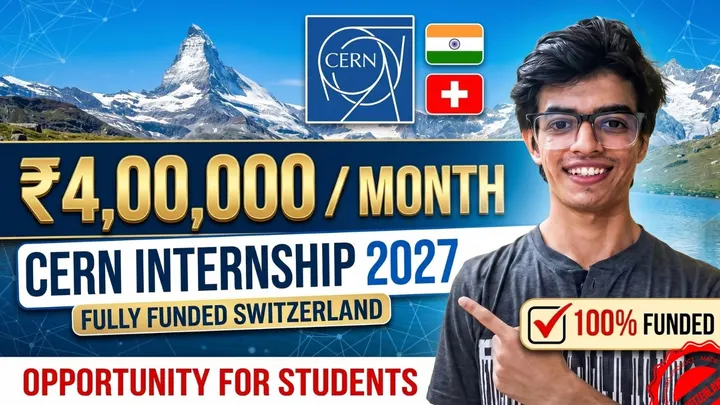
If you want a visual walk‑through of the stipend, housing, and day‑to‑day life, check out my video “₹4,00,000Month CERN Internship 2027 🇨🇭 Fully Funded Switzerland Opportunity for Students” linked above. Feel free to drop your questions in the comments or ping me on Instagram – I’m happy to help you fine‑tune any part of the process. Good luck, and see you in Geneva!
Found this useful?

Comments
Questions, experiences, thank-yous: all welcome. No sign-up needed.