How to Land a CERN Summer Student Position as an Indian Engineer
Discover the exact checklist, timelines and insider tips to secure a CERN Summer Student spot as an Indian engineering student, even with limited research experience.

Chitranshu Rajput
10 min readUpdated 13 views
When you first hear about a CERN Summer Student you probably wonder whether an Indian engineering undergrad can actually land a spot, pay the travel costs and survive the Swiss winter. The short answer is yes – thousands of students from India have done it, and the process is just a series of concrete steps. In the next few sections I’ll walk you through everything from eligibility to the visa, so you can put together a profile that stands out without guessing.
Why the CERN Summer Student Programme matters for Indian engineers
What you get out of it
- Hands‑on research with world‑class physicists, engineers and software teams. You’ll be working on detectors, data‑analysis pipelines or accelerator‑control software that shape the future of particle physics.
- A strong CV boost – CERN appears on every recruiter’s radar. Even if you later move to industry, the name signals that you can handle complex, international projects.
- Networking – you meet peers from over 60 countries and senior scientists who often become collaborators or recommenders for PhDs and jobs.
- Cultural exposure – living in Geneva for 8‑12 weeks forces you out of the comfort zone, which many Indian students later cite as the biggest personal growth factor.
Career ripple effects
A CERN stint often translates into:
- Better placement offers – many Indian tech firms (including HCL, Infosys, and multinational R&D labs) value the experience when they interview you.
- Higher chances of PhD admissions – admissions committees see the CERN badge as proof of research readiness.
- Access to a global alumni network – the CERN Summer Alumni group on LinkedIn is surprisingly active; members share job openings, post‑doc positions and even startup ideas.
So, if you’re aiming for a research career, a top‑tier engineering job, or just want a story that makes your resume pop, the programme is worth the effort.
Eligibility and key dates you must not miss
Academic requirements
| Requirement | Typical range for Indian applicants |
|---|---|
| Degree | Enrolled in a B.Tech/M.Tech (or equivalent) in Engineering, Physics, Computer Science, or a related field. |
| Year of study | Usually 3rd‑year B.Tech, 1st‑year M.Tech, or any year of a PhD program. |
| CGPA | No hard cut‑off, but a 7.0 / 10 (or 3.5 / 4) or higher puts you in a comfortable zone. If your CGPA is lower, compensate with strong projects and recommendations. |
| English proficiency | You’ll need to write a clear proposal and email; no formal test is required unless your university’s grading language is not English. |
Nationality criteria
- You must be a citizen of a non‑EU/EEA country. Indian passport holders are eligible.
- Dual citizenship is fine as long as you travel on an Indian passport.
Application timeline (2025‑2026 cycle)
| Phase | Approximate window (check CERN’s site for exact dates) |
|---|---|
| Opening of portal | Early October |
| Deadline for applications | Late January (usually the last Friday of the month) |
| Selection results | Mid‑March |
| Program start | Mid‑June to early July (8‑12 weeks) |
Mark the October opening on your calendar; the portal closes quickly once the internal review starts. Set a reminder a week before the deadline to give yourself a buffer for last‑minute tweaks.
Building a CERN‑ready profile
Selecting relevant projects
CERN looks for evidence that you can handle real‑world, data‑intensive engineering problems. Choose 1‑2 projects that showcase:
- Hardware experience – circuit design, sensor integration, FPGA programming.
- Software & data – C/C++, Python, ROOT, machine‑learning pipelines, or high‑performance computing.
- Team work – any collaborative effort, especially with a professor or an industry partner.
If you have a project that resulted in a paper, a conference poster, or a GitHub repo with decent stars, highlight it. Even a well‑documented undergraduate capstone can work if you articulate the challenge and outcome clearly.
Crafting a concise CV
CERN’s online form asks for a single‑page CV. Keep it tight:
- Header – name, contact, Indian university, current year, CGPA.
- Education – degree, university, expected graduation, relevant coursework (e.g., “Advanced Digital Signal Processing”).
- Research / Projects – bullet points, each ≤ 2 lines: what you did, how you did it, impact (e.g., “Reduced noise in sensor read‑out by 15 %”).
- Technical skills – list languages, tools, and hardware platforms; group them (Programming: C++, Python, ROOT; Hardware: VHDL, PCB design).
- Publications & Presentations – if any, give full citation.
- Extra‑curricular – leadership in clubs, hackathons, or teaching assistantships; keep it brief.
Avoid long paragraphs; recruiters skim. Use action verbs (“implemented”, “optimized”, “led”) and quantify results wherever possible.
Highlighting technical skills and programming
CERN’s experiments rely heavily on C++ and Python, plus domain‑specific tools like ROOT and Geant4. If you have exposure:
- Mention the version you used (e.g., “ROOT 6.28”).
- Cite a concrete task (“Parsed 2 GB of detector data using ROOT TTree”).
Even if you only know the basics, state your willingness to learn quickly – CERN values adaptability.
The perfect research proposal and PI outreach
Choosing a research area
Browse the CERN Summer Student Programme page; each experiment (ATLAS, CMS, LHCb, ALICE, etc.) lists “available topics”. Pick one that aligns with:
- Your current skill set (e.g., if you know FPGA, look for hardware‑trigger topics).
- Your long‑term interest (particle physics, accelerator engineering, computing).
Don’t pick a topic just because it sounds “cool”; a genuine match makes your proposal easier to write and the PI more likely to respond.
Structuring a 2‑page proposal
CERN expects a maximum of two pages, double‑spaced, 12 pt font. Follow this outline:
- Title – clear and specific (e.g., “Real‑time data compression for the ATLAS Level‑1 trigger”).
- Background (≈ 150 words) – Briefly state the scientific/technical problem. Show you understand the context; a single citation to a CERN paper is enough.
- Objective (≈ 50 words) – What you aim to achieve during the summer.
- Methodology (≈ 300 words) – Step‑by‑step plan, tools you’ll use, and milestones. Mention any prior experience that will help you execute the plan.
- Expected outcome (≈ 100 words) – Deliverables (code repository, a short report, a poster).
- Timeline (≈ 50 words) – Rough weekly breakdown; shows you’ve thought about feasibility.
Keep the language simple; avoid jargon that a non‑specialist PI might not follow. Use active voice and numbers (“process 10 GB of data per hour”).
Cold‑email template for CERN scientists
Most successful applicants contact a potential supervisor 2‑3 months before the portal opens. Here’s a template that has worked for many Indian students:
Subject: Summer Student proposal – [Your Name], B.Tech (Electronics), IIT Delhi

Dear Prof. [LastName],

I am a third‑year B.Tech student at IIT Delhi (CGPA 8.3/10) focusing on high‑speed data acquisition for particle detectors. I have designed a FPGA‑based read‑out system for a silicon tracker prototype, which reduced latency by 30 % (see attached one‑page summary).

I came across your recent work on [specific paper or project] and am particularly interested in extending the real‑time compression algorithms you presented at the 2023 CHEP conference. I would like to propose a summer project on *[brief title]* that builds on my FPGA experience and aligns with the goals of the ATLAS Level‑1 trigger team.

Would you be open to discussing a possible Summer Student collaboration? I have attached my CV and a short research outline for your reference.

Thank you for your time.

Best regards,
[Your Full Name]
[Phone – Indian code]
[LinkedIn/GitHub link]
Tips:
- Attach a one‑page CV and a one‑page project summary (not the full proposal).
- Personalise the first two lines – mention a specific paper or talk.
- Keep the email under 150 words; busy scientists skim quickly.
If you receive a positive reply, you can refine the proposal together and mention the PI’s name in the CERN application form.
Securing funding and handling the visa process
CERN stipend details
CERN provides a monthly stipend that covers accommodation, meals and a modest living allowance. The exact amount varies by year but typically falls in the €2,500–€3,000 range. It is paid directly to your bank account; you do not need to arrange a separate scholarship.
Travel grant options
While the stipend is generous, you still need to cover flight tickets and insurance. Indian students often tap into:
- University travel grants – many Indian institutes have a small pool for international conferences and internships.
- MHRD/UGC scholarships – check if your college offers a “research travel assistance” scheme.
- Private sponsors – some alumni or industry partners (e.g., HENNGE, Woven) have ad‑hoc funds for promising interns.
Apply for these grants as soon as you receive the acceptance email; flights to Geneva fill up fast in summer.
Step‑by‑step Schengen visa checklist for Indian students
- Acceptance letter from CERN – PDF, signed, with program dates.
- Proof of financial means – recent bank statement showing at least €10,000 (CERN’s official figure) or the stipend confirmation.
- Travel insurance – minimum coverage €30,000 for medical emergencies, valid for the whole stay.
- Passport – at least 6 months validity beyond your intended return date, with two blank pages.
- Visa application form – fill online (France’s VFS portal) and print the confirmation.
- Photographs – 35 mm × 45 mm, white background, recent.
- Cover letter – a short note (½ page) stating purpose of travel, duration, and that you will return to India after the internship.
- Proof of accommodation – CERN’s housing confirmation or a rental agreement in Meyrin.
- Flight reservation – a “dummy” reservation (not paid) is acceptable; many agencies provide this for visa purposes.
Submit the dossier at the VFS Centre in New Delhi (or the nearest VFS office). Appointments fill up quickly in the months before June, so book at least four weeks in advance. After submission, the standard processing time is 10‑15 working days, but keep a buffer for any additional document requests.
Preparing for life at CERN
Accommodation options on the Meyrin site
CERN offers on‑site housing for summer students:
| Type | Typical cost (CHF/month) | What you get |
|---|---|---|
| Student Residence (CERN House) | 800–1,100 | Single room, shared kitchen, laundry, Wi‑Fi, close to the campus. |
| Private apartments | 1,200–1,600 | One‑bedroom flat, more privacy, slightly farther (short bus ride). |
Apply through the CERN Housing portal as soon as you receive the acceptance email; spots are limited and allocated on a first‑come, first‑served basis. If you prefer a private flat, start searching on Swiss rental platforms (Homegate, ImmoScout24) early – the market is tight in June.
Cultural adjustments
- Language – French is the local language, but English is the working language at CERN. A few basic French phrases (bonjour, merci, où est…) go a long way for grocery trips.
- Cost of living – Switzerland is expensive; the stipend is calibrated for that, but budgeting helps. Cook simple meals at the residence kitchen to stretch euros.
- Work rhythm – Expect a flexible schedule; you may have lab work in the morning and a seminar in the afternoon. Punctuality is valued, but you’ll also find a relaxed cafeteria culture.
Essential paperwork and insurance
- European Health Insurance Card (EHIC) – not available for Indians, so your private travel insurance must cover hospitalisation.
- CERN ID badge – you’ll receive it on the first day; it doubles as a building access card and a cafeteria payment card.
- Bank account – opening a Swiss account is optional; you can receive the stipend via SEPA transfer to an Indian bank that supports international SWIFT.
Common pitfalls and how to avoid them
| Pitfall | Why it hurts | Fix |
|---|---|---|
| Submitting a generic CV | Recruiters can’t see relevance to CERN’s technical needs. | Tailor every bullet to the chosen experiment; use the same keywords from the topic description. |
| Skipping the PI email | Without a supervisor’s interest, your application may be flagged as “no match”. | Email at least two potential PIs; follow up politely after a week if you hear nothing. |
| Leaving the proposal vague | Reviewers think you haven’t thought through feasibility. | Include a clear methodology, tools, and a week‑by‑week plan. Keep it under two pages. |
| Ignoring the visa timeline | Late visa leads to missed start date or rushed travel. | Book the VFS appointment as soon as you have the acceptance letter; keep copies of all documents. |
| Under‑budgeting for living costs | Running out of money forces you to cut meals or leave early. | Use CERN’s stipend calculator (available on their site) to draft a weekly budget; include transport, food, and occasional outings. |
| Assuming English is enough | Some internal meetings use French or German; lack of basic language can isolate you. | Learn 10‑15 everyday French phrases before you leave; the CERN language centre offers quick crash courses. |
Your next steps
- Mark the portal opening – set a calendar reminder for early October.
- Identify 2‑3 experiments that match your skill set; note their topic titles.
- Prepare a one‑page project summary for each relevant experience you have.
- Draft the cold‑email (use the template above) and send it to the PIs you’ve shortlisted.
- Polish your CV to one page, focusing on quantifiable achievements.
- Write the 2‑page proposal once a PI shows interest; ask for feedback.
- Submit the online application before the January deadline, double‑checking every required field.
- Apply for travel grants as soon as you get the acceptance email.
- Start the visa paperwork; book the VFS appointment early.
If you follow these steps methodically, you’ll move from “maybe someday” to a concrete, funded summer at CERN.
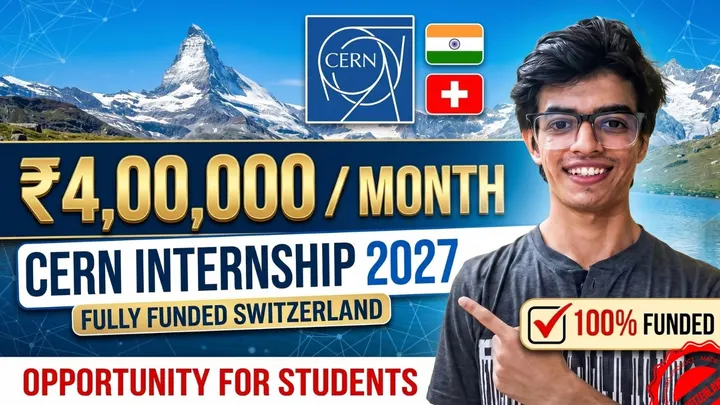
I’ve covered the whole roadmap here, and I also walk through my own experience in the video “₹4,00,000Month CERN Internship 2027 🇨🇭 Fully Funded Switzerland Opportunity for Students” – give it a watch for a quick visual recap and a few extra tips on packing and daily life.
Feel free to drop your questions in the comments or ping me on Instagram @lifeofkittukun. Good luck, and see you in Geneva!
Found this useful?


Comments
Questions, experiences, thank-yous: all welcome. No sign-up needed.