How to Crack the CERN Summer Student Programme for Indian Engineers
Dreaming of a CERN summer? This guide walks Indian engineering students through every requirement, from building a research CV to acing the technical interview, so you can land a fully funded spot.

Chitranshu Rajput
8 min readUpdated 7 views
CERN’s Summer Student Programme is one of those rare chances that feels like a myth when you’re studying engineering in India. You see the pictures of the gigantic detectors, hear about the Nobel‑winning experiments, and wonder if a student from a Tier‑2 college can ever step inside the 27‑kilometre tunnel. The short answer is: yes, you can. The longer answer is a roadmap that turns a modest CGPA into a solid chance of getting the slot. Below is the step‑by‑step plan I use when I coach juniors, broken down into what you need to know, what you need to do, and how to survive the interview and the paperwork.
Why CERN Summer Student Programme Matters
CERN isn’t just a particle‑physics lab; it’s a global engineering playground. The infrastructure – from cryogenics to data‑center farms – needs electrical, mechanical, software and control‑systems engineers just as much as physicists.
What you gain:
- Hands‑on work on world‑class hardware (e.g., the ATLAS muon chambers) or on massive software stacks that process petabytes of data.
- Network with researchers from over 100 countries; a single summer can give you contacts that last a decade.
- Stipend and perks – the programme typically covers travel, accommodation in the on‑site housing, and a monthly stipend that comfortably exceeds the cost of living in Geneva for a student. It’s fully funded, so you don’t have to dip into family savings.
For an Indian engineer, the experience looks impressive on any resume and often translates into better campus placements, PhD offers, or even a job at a multinational R&D centre.
Eligibility Checklist for Indian Applicants
| Requirement | What CERN expects | What most Indian students actually have |
|---|---|---|
| Academic level | Enrolled in a Bachelor’s or Master’s programme (final year) in engineering, physics, computer science or related | 3‑year B.Tech or 4‑year B.E. (final year) or a 2‑year M.Sc. |
| CGPA | No strict cut‑off, but most successful candidates have ≥ 7.5/10 (or equivalent). Lower CGPA can be compensated with strong research exposure. | 6.5‑7.0 is common; you’ll need extra points elsewhere. |
| Field of study | Electrical, mechanical, computer, software, control, instrumentation, data‑science, or physics. | Any engineering branch works if you can link it to CERN’s projects. |
| Language | Good English – both written (motivation letter) and spoken (interview). | English is usually fine; proofread your documents. |
| Visa | Schengen short‑stay (type D) student visa. Must have a valid passport, travel insurance, and an invitation letter from CERN after selection. | Apply through the Swiss embassy/consulate in India; start early. |
Quick checklist before you start the application:
- Final‑year status confirmed by your university.
- CGPA transcript (official PDF).
- Two recommendation letters (one academic, one from a supervisor of a research project).
- Passport with at least six months validity beyond the planned end date.
If any of these are missing, put a plan in place now – e.g., ask a professor for a draft recommendation while you finish the project.
Building a Research Profile from Scratch
A modest CGPA can be offset by a clear research narrative. Here’s how to create one even if your college doesn’t have a dedicated particle‑physics lab.
1. Pick a project that maps to CERN’s domains
- Control‑systems: Build a PID controller for a small robotic arm and log the data.
- Data‑analysis: Use Python to analyse a public dataset from the LHC Open Data portal; reproduce a simple plot from a published paper.
- Electronics: Design a low‑noise amplifier board and test it with a photodiode.
The key is to choose something you can finish within one semester and that lets you write a short technical report.
2. Leverage Tier‑2 college resources
- Professors with industry ties: Even if they aren’t CERN‑connected, a professor who has worked on satellite or automotive R&D can guide you on experimental methodology.
- College labs: Use the electronics workshop, the micro‑controller lab, or the computing centre. If equipment is limited, simulate parts of the experiment in MATLAB/Simulink or LTspice.
- Online MOOCs: Courses on accelerator physics, CERN data analysis (CERN‑OpenLab), or embedded systems give you terminology that will impress reviewers.
3. Get strong recommendation letters
- Ask early: Approach the professor after you’ve delivered a prototype or a report.
- Provide a brief: Give them a one‑page summary of the project, your role, and the skills you demonstrated. This makes it easier for them to write a focused letter.
- Highlight relevance: If the professor can mention how your work aligns with CERN’s needs (e.g., “demonstrated proficiency in real‑time data acquisition”), that adds weight.
Crafting a Winning Application
CERN’s portal is straightforward, but the competition is fierce. Treat every field as a chance to stand out.
Motivation Letter – the heart of the file
- Opening paragraph (2‑3 lines): State the programme you’re applying for, your current degree, and a one‑sentence hook – e.g., “I want to contribute to the ATLAS detector upgrade by applying my experience in low‑noise electronics.”
- Why CERN? (1 paragraph): Mention a specific CERN experiment or technology that excites you and tie it to your project. Show you’ve done homework.
- What you bring (2‑3 paragraphs): Summarize your project, the skills (programming, CAD, data analysis), and any teamwork experience. Quantify where possible – “processed 2 TB of raw data using ROOT, reducing analysis time by 30 %.”
- Future vision (1 paragraph): Explain how the summer will shape your career – e.g., “The exposure will help me pursue a PhD in accelerator engineering and later work on next‑generation colliders.”
- Closing line: A polite thank‑you and a note that you’re eager to discuss your fit in an interview.
Tip: Keep the letter under 800 words. Use simple sentences; avoid jargon unless you’re sure the reviewer knows it.
Online Form – avoid common pitfalls
- Copy‑paste errors: Fill each field directly; don’t rely on browser auto‑fill for university names – they often truncate.
- Document naming: Follow CERN’s convention –
Lastname_Firstname_CV.pdf,Lastname_Firstname_Transcripts.pdf. - File size: Keep each PDF under 5 MB; compress images if needed.
- Deadline awareness: The portal shows a “closing date” in GMT; convert to IST and set a personal deadline a week earlier.
Supporting Documents
- CV: One‑page, reverse‑chronological. Include GPA, project title, tools used, and any publications (even pre‑prints).
- Transcript: Official PDF from the university portal; if it’s in Hindi, attach an English translation.
- Recommendation letters: PDFs, signed and on the professor’s letterhead.
Double‑check that every PDF opens correctly on a different device – a corrupted file is an instant reject.
Cold‑Emailing CERN Researchers
A well‑targeted email can land you a supervisor who will champion your application inside CERN’s internal review.
1. Identify the right groups
- Browse the CERN Research Groups page; look for “Detector Development”, “Accelerator Controls”, “Computing & Data”.
- Note the names of group leaders and post‑docs whose recent papers match your interests.
- Use Google Scholar to find a paper published in the last 2 years; copy the DOI – it shows you’re up‑to‑date.
2. Email structure (keep it under 200 words)
| Part | Content |
|---|---|
| Subject | “Summer Student application – interest in [Group Name] – [Your Name]” |
| Greeting | “Dear Dr [LastName],” |
| Intro (1 sentence) | State who you are, your university, and the programme you’re applying for. |
| Connection (1‑2 sentences) | Mention the specific paper or project that caught your eye and why it resonates with your work. |
| Value proposition (2 sentences) | Briefly describe your relevant project and the skill you can bring. |
| Ask (1 sentence) | Request a short 15‑minute chat or ask if they are willing to supervise a summer student. |
| Closing | “Thank you for your time. I look forward to hearing from you.” + signature with phone and LinkedIn link. |
3. Timing and follow‑up
- Send on a weekday morning (IST) – it lands in Europe’s afternoon inbox.
- First follow‑up: After 5 business days, send a polite reminder – “Just checking if you had a chance to read my previous mail.”
- Second follow‑up: If there’s still no reply after another week, you can move on to another group. Don’t spam the same researcher.
Technical Interview Preparation
CERN’s interview mixes technical depth with motivation. You’ll usually face a panel of 2‑3 scientists/engineers for 30‑45 minutes.
Core topics to review
| Area | Sample questions |
|---|---|
| Physics basics | “What is the purpose of a calorimeter?” “Explain the principle of a synchrotron.” |
| Control systems | “How would you design a feedback loop for a magnet power supply?” |
| Programming | “Write a Python snippet to read a ROOT file and plot a histogram.” |
| Electronics | “Describe how you would filter noise from a sensor signal.” |
| Data handling | “What are the challenges of processing 1 PB of data, and how would you mitigate them?” |
Practice resources
- CERN Open Data portal – download a small dataset and reproduce a plot from a published paper.
- LeetCode / HackerRank – focus on data‑structure problems that involve arrays and file I/O.
- MIT OCW “Signals and Systems” – quick refresher on filters and PID controllers.
Mock interview tips
- Record yourself answering a question, then listen for filler words and unclear explanations.
- Ask a peer (preferably someone with research experience) to play the panel. Give them a list of typical questions.
- STAR method for behavioural parts: Situation, Task, Action, Result – keep the answer under 2 minutes.
During the real interview, if you don’t know an answer, admit it and outline how you would find the solution. Reviewers value problem‑solving attitude over rote knowledge.
Post‑Selection: Visa, Travel and Arrival
Congratulations! Now the logistics kick in. Here’s what to sort out within the first two weeks after the offer.
Student visa for Switzerland
- Invitation letter from CERN (sent by the HR office).
- Visa application at the Swiss consulate in New Delhi or Bengaluru – fill the online form, book an appointment, and bring: passport, invitation, proof of accommodation (CERN housing confirmation), travel insurance, and a recent bank statement showing you can cover incidental expenses.
- Processing time is usually 2‑3 weeks, but start early; any delay can push your flight back.
Budgeting for living costs
- Accommodation: CERN provides on‑site housing (shared apartments). The cost is deducted from the stipend, leaving you with roughly €1 200–1 400 per month for food, transport, and leisure.
- Food: Campus canteens are cheap; a typical meal costs €5‑7.
- Transport: A monthly Swiss Travel Pass for public transport is around €80 – worth it if you plan to explore Geneva.
Create a simple spreadsheet: stipend → housing deduction → net → monthly expenses. Aim to keep a buffer of €200 for unexpected items.
First‑day expectations
- Orientation: CERN runs a two‑day induction covering safety, IT access, and lab tours. Attend all sessions – they’re also a networking goldmine.
- Badge and access: You’ll receive a personal badge that grants entry to the site. Keep it on you at all times.
- Team integration: Your supervisor will assign a “buddy” – treat them as your go‑to for lab protocols and local tips.
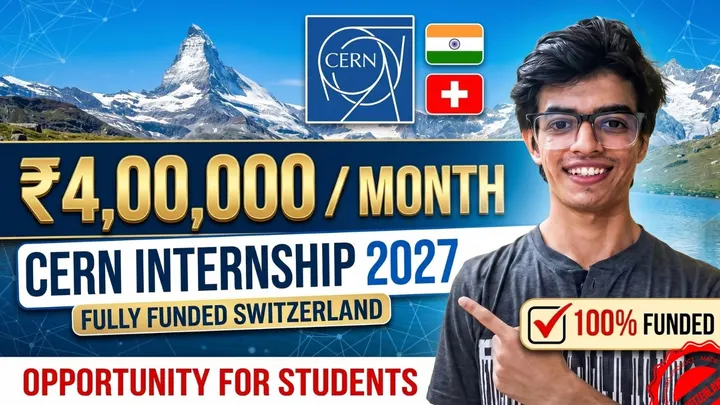
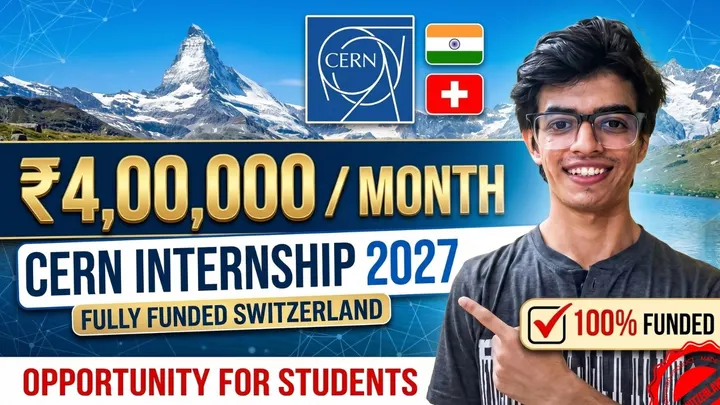
If you’re still unsure about any step, check the official CERN Summer Student page (it has the latest forms and FAQs). And if you want a visual walkthrough of the whole process, my video “₹4,00,000Month CERN Internship 2027 🇨🇭 Fully Funded Switzerland Opportunity for Students” walks through each stage, from the first email to the day you step onto the Meyrin campus.
Good luck, and remember that persistence beats perfection. Drop a comment below if any part of the roadmap feels fuzzy – I’ll try to clear it up. Happy applying!
Found this useful?
Comments
Questions, experiences, thank-yous: all welcome. No sign-up needed.