EPFL & ETH Zurich Summer Fellowships: An Honest Insider’s Guide
Discover the true steps, challenges, and tips to secure a summer research fellowship at EPFL or ETH Zurich, from application hacks to budgeting and leveraging the experience for future opportunities.

Chitranshu Rajput
8 min readUpdated 1 view
EPFL & ETH Zurich Summer Fellowships: An Honest Insider’s Guide
If you’re wondering whether a short stint in a Swiss lab can actually move your CV forward, the answer is a clear yes. Both EPFL and ETH Zurich run summer research fellowships that are respected across Europe and Asia, and many Indian students return with a stronger profile, new contacts, and a taste of world‑class research.
Below I walk you through what the programs look like, how to apply without getting lost in bureaucracy, and what to do once you land in Lausanne or Zurich. I’ve been through a similar process for a different Swiss internship, so I know the anxieties – low CGPA, limited funding, the dreaded “cold‑email” to a professor. Let’s break it down step by step.
Why EPFL and ETH Zurich Summer Fellowships Matter
Prestige that really shows up on paper
Both institutions rank among the top ten in Europe for engineering and natural sciences. A summer fellowship from either university signals that you have worked in a highly competitive environment. Admissions committees for PhD programmes in Europe, the US, and even Indian institutes often ask for “research experience abroad”; a Swiss stint checks that box instantly.
Tangible benefits beyond the badge
| What you get | How it helps you |
|---|---|
| Hands‑on research (usually 6–12 weeks) | Gives you data, a possible conference abstract, or at least a solid paragraph for your SOP |
| Mentor reference | Professors at EPFL/ETH are well‑connected; a strong letter can open doors to PhDs or industry R&D jobs |
| International network | Fellow students from Europe, US, and Asia become collaborators or job leads later |
| Swiss work culture exposure | Shows future employers you can adapt to high‑tech, punctual environments |
Eligibility and Selection Criteria Deep Dive
Academic requirements
Most labs look for students in the final year of B.Tech/M.Tech or a master’s programme, with a CGPA roughly equivalent to 7.0 / 10 (or 3.5 / 4). If your CGPA is lower, you can still be considered if you have strong project work, publications, or a compelling personal statement that explains the dip.
Language proficiency
English is the working language in both universities. A TOEFL iBT score above 80 or IELTS 6.5 is usually enough. Some labs, especially in the life sciences, may ask for basic French (EPFL) or German (ETH) for daily life, but it’s not a selection filter.
Research experience expectations
- Lab work: At least one semester of project work, an undergraduate thesis, or a published conference paper.
- Coding / simulation: For CS or EE labs, a GitHub portfolio or a short demo helps.
- Coursework: Relevant electives (e.g., signal processing for a communications lab) strengthen your case.
Common pitfalls
- Applying with a generic CV – Swiss professors skim for specific skills; a one‑page CV tailored to the lab’s recent papers is a must.
- Over‑promising in the research proposal – Claiming you’ll deliver a full prototype in six weeks raises eyebrows. Keep the scope realistic.
- Missing the “supervisor approval” step – Many labs only forward applications that have already received a nod from the PI. Cold‑email early and get a short “yes” before you submit.
Step‑by‑Step Application Process
1. Finding suitable labs and supervisors
- Start early – Lab pages on EPFL’s “Research” portal and ETH’s “Institute” pages are updated each semester.
- Use keywords – If you’re into robotics, search “EPFL humanoid robotics” or “ETH autonomous systems”.
- Check recent publications – A paper from the last year shows the lab is active. Download it, read the abstract, and note any tools you’re familiar with.
2. Crafting a targeted cover letter and CV
Cover letter (max 300 words)
- First line – Mention the exact fellowship name and the lab you’re applying to.
- Why that lab – Cite a recent paper and say how it aligns with your skills.
- What you bring – List two‑three concrete experiences (e.g., “developed a real‑time image‑processing pipeline in Python for my senior project”).
- What you hope to achieve – A short, realistic goal (“extend the control algorithm to handle uneven terrain”).
CV checklist
- One page, clear headings (Education, Projects, Publications, Skills).
- Use bullet points, start each with an action verb (“Implemented”, “Analyzed”).
- Include a link to your GitHub/portfolio.
3. Preparing a concise research proposal
- Length: 1 page, 600–800 words.
- Structure
- Background – One sentence summarizing the lab’s current work.
- Objective – What you aim to explore in the summer (e.g., “evaluate the robustness of the existing SLAM algorithm under low‑light conditions”).
- Method – Briefly list tools, datasets, or simulations you’ll use.
- Expected outcome – A deliverable that can be a report, a set of plots, or a prototype demo.
Avoid jargon that the PI might not use; keep it readable for a non‑specialist committee member.
4. Securing recommendation letters
- Who to ask – Ideally a professor who supervised a research project or a senior faculty member who knows your academic record.
- Give them a kit – Send a PDF with your CV, the fellowship description, and bullet points of what you’d like highlighted (e.g., “ability to work independently”).
- Timeline – Ask at least three weeks before the portal deadline; give a gentle reminder a week prior.
5. Online portal submission checklist
| Item | Where to upload | Tips |
|---|---|---|
| Application form | EPFL/ETH portal | Double‑check spelling of your name (matches passport). |
| Cover letter | Use the same file name for all documents (e.g., KittuKun_EPFL_Cover.pdf). |
|
| CV | Keep font size readable (11 pt). | |
| Research proposal | Include the lab’s name in the header. | |
| Recommendation letters | Uploaded by referees | Ask them to submit directly; you can’t upload on their behalf. |
| Transcript | PDF (official) | If you have a provisional grade, attach a note explaining the pending result. |
| Language test score | PDF (if required) | Only if the lab explicitly asks. |
After hitting “submit”, you’ll receive an automated email. Keep that for reference; some labs ask for the application ID when they reply.
Funding, Stipends, and Living Costs
Typical stipend amounts and coverage
- EPFL – Summer fellowships usually offer a stipend in the range of CHF 2,500–3,200 for 8‑weeks.
- ETH Zurich – Similar figures, often quoted as “up to CHF 3,000”.
Both amounts are meant to cover basic living expenses, not tuition (the fellowship is tuition‑free).
Housing options and costs
| City | Common housing | Approx. monthly cost |
|---|---|---|
| Lausanne (EPFL) | Student dorms (Cité‑Campus) | CHF 600–800 |
| Lausanne | Private shared flat (WG) | CHF 800–1,200 |
| Zurich (ETH) | ETH dorms (Zimmer) | CHF 700–900 |
| Zurich | Private WG | CHF 1,000–1,400 |
Dorms are cheapest but fill up fast. Apply for housing as soon as you get the acceptance email; most universities have a separate portal for summer guests.
Budgeting tips
- Cook at home – Supermarkets (Migros, Coop) have ready‑to‑eat meals for ~CHF 5.
- Transport – A monthly Zurich public‑transport pass is ~CHF 80; Lausanne’s “Mobilis” zone pass is similar. Many labs provide a transport voucher, so ask.
- Insurance – Swiss law requires health insurance. Some fellowships include a basic coverage; if not, a short‑term plan from a provider like “Allianz” costs ~CHF 30–40 per week.
Convert everything to INR using the current rate and add a 10 % buffer for unexpected expenses.
Preparing for Arrival: Logistics and Culture
Visa application timeline
- Type – “Student Intern” (Schengen short‑stay) visa.
- When to apply – As soon as you receive the official invitation letter (usually within a week of acceptance). Indian applicants should book the appointment at the Swiss consulate at least 3–4 weeks in advance.
- Documents – Invitation letter, proof of stipend, travel insurance, bank statement showing at least CHF 5,000, and a completed visa form.
Travel and health insurance
Even if the fellowship includes a basic health cover, I recommend a supplemental travel insurance that also covers flight cancellations. Companies like “Coverfox” or “ICICI Lombard” have plans starting at INR 2,500 for a month.
Cultural adjustments and networking tips
- Punctuality – Swiss labs start meetings on time; set a reminder 5 minutes before.
- Language – English works everywhere, but learning a few French phrases (EPFL) or German greetings (ETH) goes a long way. “Merci” or “Danke” after a lab demo earns a smile.
- Social life – Join the university’s “International Student” groups on WhatsApp; they organise weekend hikes, which are a cheap way to see the Alps and meet peers.
Making the Most of Your Fellowship
Setting research goals
- Define a “SMART” objective – Specific, Measurable, Achievable, Relevant, Time‑bound. For example, “Implement a data‑augmentation pipeline that improves model accuracy by at least 3 % on the lab’s benchmark dataset by week 6.”
- Weekly check‑ins – Schedule a short 15‑minute meeting with your supervisor every Friday. Use it to report progress and adjust scope.
Building relationships with mentors
- Ask for feedback – Don’t wait for the formal review; request a quick comment on your code or experiment design.
- Offer help – If the lab is running a parallel project, a few hours of assistance shows initiative and may lead to a co‑authored paper later.
Leveraging the experience for future scholarships or jobs
- Update your CV – Add a line: “Summer Research Fellow, EPFL – Developed X, presented results at Y conference (poster)”.
- Request a detailed recommendation – When the fellowship ends, politely ask the PI for a letter that mentions specific achievements (e.g., “delivered a working prototype within the allocated timeframe”).
- Showcase on LinkedIn – Post a short write‑up with a photo of your lab bench; recruiters notice Swiss experience.
After the Fellowship: Next Steps
Obtaining recommendation letters
Send a polite email within a week of your departure, thanking the supervisor and attaching a draft of the letter you’d like them to sign. Most professors appreciate the template and will tweak it.
Using the experience in graduate applications
- Statement of Purpose – Dedicate a paragraph to the Swiss project, highlighting the problem you tackled, the methodology, and the outcome.
- Publications – If your work yielded data or a novel algorithm, discuss turning it into a conference paper. Even a poster at a local symposium adds weight.
Staying connected with the Swiss research community
- Alumni groups – EPFL and ETH maintain “Summer Fellow Alumni” mailing lists. Subscribe and attend the annual virtual meet‑up.
- Follow‑up projects – Some labs keep summer fellows as part‑time contributors for the next academic year; keep an eye on their “Open Positions” page.
I hope this walkthrough clears the fog around EPFL and ETH Zurich summer fellowships. The process is a bit bureaucratic, but the payoff—both on paper and in experience—is well worth the effort.
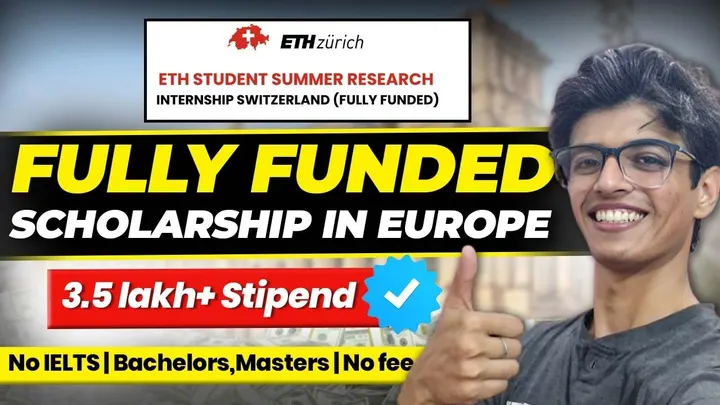
If you have any specific doubts—like how to phrase that cold email or which housing portal to use—drop a comment below or watch the companion video where I walk through a sample application screen by screen. Good luck, and see you in Switzerland!
Found this useful?

Comments
Questions, experiences, thank-yous: all welcome. No sign-up needed.