Mastering EPFL and ETH Zurich Summer Fellowships: A Practical Blueprint
Learn the exact actions—timeline, CV tweaks, professor outreach, and funding hacks—to secure a summer fellowship at EPFL or ETH Zurich, even if your profile isn’t stellar.

Chitranshu Rajput
8 min readUpdated 1 view
EPFL and ETH Zurich summer fellowships are on many Indian students’ wish‑lists, but the application process can feel like a maze, especially if your CGPA isn’t perfect and you’ve never done research abroad. Below I walk through exactly what you need to turn a modest CV into a solid, fundable proposal—step by step, with checklists you can copy‑paste.
Why EPFL and ETH Zurich Summer Fellowships Matter
Prestige and networking benefits
Both EPFL (École polytechnique fédérale de Lausanne) and ETH Zurich sit at the top of European engineering and science rankings. A few weeks in a Swiss lab instantly adds a heavyweight line to your résumé and gives you access to professors who sit on advisory boards of multinational R&D units. The alumni network is global; many past fellows land full‑time offers or PhD spots in Europe, the US, and even back in India’s top research labs.
Funding details
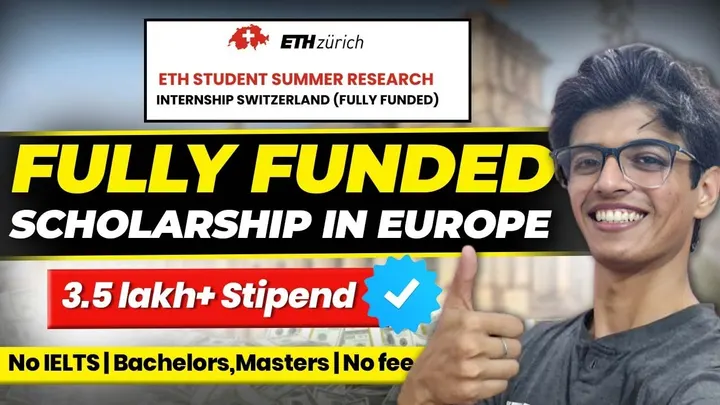
The summer programmes typically cover travel, a modest monthly stipend (enough for basic living in Lausanne or Zurich), and sometimes a housing allowance. The exact amount varies each year, but you can expect a stipend that covers meals, public transport, and a small rent contribution. There are no tuition fees because the programmes are fully funded.
Career impact for Indian students
A Swiss summer stint looks great on campus placement drives. Recruiters at firms like Bosch, Siemens, and even Indian tech giants see Swiss experience as a signal of adaptability and high‑quality research exposure. It also gives you concrete project work to discuss in interviews—much better than a generic “I did a project in college”.
Eligibility Deep Dive and Choosing the Right Programme
Differences between EPFL and ETH programmes
| Feature | EPFL Summer Fellowship | ETH Zurich Summer Research |
|---|---|---|
| Typical duration | 6–8 weeks (June‑July) | 8–10 weeks (June‑August) |
| Main focus | Engineering, life sciences, data science | Physics, chemistry, computer science, engineering |
| Application portal | EPFL Summer Academy website | ETH Summer Research portal |
| Lab selection | Often pre‑matched via project list | You contact professor first, then apply |
EPFL tends to bundle projects under “summer schools” that are more structured, while ETH gives you more freedom to propose a custom project with a professor you’ve already spoken to.
Academic and language requirements
- CGPA – Both schools expect at least a 6.5/10 (or equivalent). If you’re lower, compensate with strong project work, publications, or a compelling motivation letter.
- English – Required for all documents; a TOEFL/IELTS score is not mandatory if you’ve studied in English.
- German/French – Not needed for the fellowship itself, but knowing a few basics helps with daily life in Zurich/Lausanne.
Assessing fit based on research interests
- List your top three research themes (e.g., renewable energy, bio‑electronics, AI for materials).
- Map them to labs – Use EPFL’s “Research Units” page and ETH’s “Institute Directory”.
- Check recent publications – If a professor’s work in the last 2 years aligns with your interests, that’s a good sign they’re actively taking students.
If you’re torn between two labs, pick the one where you can realistically contribute within a few weeks—look for projects that involve data analysis, simulation, or short‑term experiments rather than long‑term synthesis.
Crafting a Research‑Focused CV and Statement
Highlighting projects and coursework
- Project section – Use bullet points, start each with an action verb, and quantify impact.
Example: “Developed a MATLAB model for solar‑cell efficiency, improving prediction accuracy by 12 % compared to textbook formulas.” - Coursework – List only the most relevant courses (e.g., “Advanced Control Systems”, “Molecular Modeling”). Include the grade if it’s strong.
- Skills table – Languages (Python, C++, LabVIEW), tools (COMSOL, TensorFlow), and lab techniques (SEM, PCR). Keep it to one line per skill category.
Tailoring the CV for Swiss labs
Swiss professors appreciate clarity and brevity. Keep your CV to one page (two only if you have publications). Use a clean, sans‑serif font and leave ample white space. Put the lab name you’re applying to right under the heading “Target Lab” – it shows you’ve customized the document.
Writing a concise, impact‑driven statement of purpose
- Opening line – State the specific lab and project you aim to join.
“I am eager to join Prof. Anna Müller’s group at ETH Zurich to work on machine‑learning‑assisted catalyst design.” - Why you – Summarize one or two past experiences that directly prepare you for the task.
- Why the lab – Mention a recent paper or a technique the professor uses and how it resonates with your goals.
- Future vision – Briefly explain how the fellowship fits into your career plan (e.g., “I intend to pursue a PhD in sustainable catalysis and this project will give me the required experimental foundation.”).
Keep the statement under 500 words and avoid generic phrases like “I have always been passionate about science”. Specificity beats enthusiasm on paper.
Finding and Contacting the Ideal Professor
Using university portals and research databases
- EPFL – Go to https://www.epfl.ch/research/, click “Research Units”, then filter by “Engineering” or “Life Sciences”.
- ETH – Use https://ethz.ch/en/research/department.html, then select the relevant institute.
For a quicker sweep, Google Scholar with the lab name and “2023” will show the most recent publications.
Personalising cold emails
A typical cold email to a Swiss professor should be under 200 words:
Subject: Summer 2026 – Interest in your work on [specific topic]

Dear Prof. [Last Name],

My name is Chitranshu Rajput, a final‑year B.Tech student at NSUT Delhi (CGPA 7.2). I was impressed by your recent paper on [title] where you [key finding]. I have hands‑on experience with [relevant technique] from a project on [brief description].

I am looking for a 6‑week summer research placement and would love to contribute to your work on [specific aspect]. I have attached my CV and a short research‑statement for your reference.

Would you be open to discussing a possible project? I can start from early June and will be able to fund my travel.

Thank you for your time.

Best regards,
Chitranshu (KittuKun)
Phone: +91‑XXXXXXXXXX
Key points
- Mention a specific paper – shows you actually read their work.
- Highlight one concrete skill that matches their needs.
- Attach CV and a one‑page research statement; don’t embed large PDFs in the email body.
Showcasing alignment with the professor’s work
After the professor replies, suggest a mini‑proposal (2–3 paragraphs) that outlines a feasible task you could finish in the summer. Keep it realistic: data analysis, simulation, or a small experimental setup that complements their ongoing project.
Application Timeline and Checklist
Below is a typical flow; exact dates shift each year, so always verify on the official portal.
| Milestone | Approx. window | Action |
|---|---|---|
| Research & professor outreach | Jan‑Feb | Identify labs, send cold emails, secure a mentor’s “letter of support”. |
| Prepare documents | Feb‑Mar | CV, statement of purpose, transcripts, language proof (if needed). |
| Online application submission | Late March‑Early April | Fill portal forms, upload PDFs, pay any nominal fee. |
| Interview (if any) | April‑May | Short video call – prepare to discuss your project idea. |
| Acceptance & visa invitation | May‑June | Receive invitation letter, start visa process. |
| Travel & accommodation booking | Mid‑June | Arrange flight, confirm housing with the lab or university dorm. |
Checklist (copy‑paste)
- List of 3–5 target labs (with professor names, recent paper links)
- Tailored CV (1 page)
- One‑page research statement (personalised per lab)
- Academic transcripts (official PDF)
- English proficiency proof (if required)
- Signed “Letter of Support” from professor (email attachment)
- Completed online application form (EPFL or ETH)
- Proof of travel insurance (often requested)
Common pitfalls and how to avoid them
- Sending generic emails – Professors receive dozens; a vague email gets ignored.
- Over‑promising – Propose a project you can realistically finish in 6–8 weeks.
- Late document uploads – The portal locks a week before the deadline; finish everything a week early.
- Neglecting visa timing – Swiss student visas can take 4–6 weeks; start as soon as you have the invitation letter.
Funding, Visa, and Logistics Made Simple
Stipend usage and budgeting tips
The stipend usually covers:
- Rent – Expect a shared flat or university dorm costing ₹30‑40 k per month.
- Food – Swiss groceries are pricey; budgeting ₹15‑20 k per month is safe.
- Transport – Public transport passes (Zurich/Lausanne) are about ₹5 k per month.
Create a simple spreadsheet: stipend – (rent + food + transport + misc). Most fellows find a small surplus for travel or a short weekend trip.
Swiss student visa process for Indian nationals
- Gather documents – Invitation letter, proof of funds (bank statement showing at least CHF 4 k), passport (valid >6 months), recent photos.
- Book appointment – Apply through VFS Global; slots fill fast in March, so book ASAP after acceptance.
- Submit & pay fee – Around ₹7 k.
- Biometrics & interview – Usually a brief interview; bring your acceptance letter and a short note on why you’re going.
Processing time is typically 4‑5 weeks, but can stretch during peak season. Track the application on the Swiss embassy portal.
Accommodation and travel planning
- University housing – Both EPFL and ETH run “student residences” for summer fellows. Apply through the same portal you used for the fellowship; spots are limited, so request early.
- Private rentals – Websites like wg-gesucht.ch (German) or students.ch list short‑term rooms.
- Flights – Book a month in advance for the best rates; consider flying into Geneva for EPFL and Zurich for ETH.
Remember to get travel insurance that covers health and repatriation—Swiss healthcare is excellent but expensive without insurance.
Post‑Selection: Preparing for a Successful Summer
Pre‑arrival reading and skill building
- Read the professor’s latest 2–3 papers – Note the methods and tools they use.
- Brush up on required software – If the lab uses Python for data analysis, complete a short Kaggle tutorial.
- Learn basic Swiss German or French phrases – “Grüezi” (hello) or “Bonjour” go a long way in the lab lounge.
Setting research goals
Write a personal project plan (one page) with:
- Goal – e.g., “Generate a dataset of 500 catalyst compositions and train a regression model”.
- Milestones – week 1: literature review, week 2‑3: data collection, week 4‑5: model building, week 6: write a short report.
Share this plan with your supervisor before you arrive; it shows initiative and helps them allocate resources.
Networking strategies for the fellowship period
- Attend weekly lab meetings – Even if you’re a short‑term member, ask a question; it signals engagement.
- Join university social events – EPFL’s “Summer Academy” mixers and ETH’s “Research Café” are low‑key ways to meet peers from other labs.
- Exchange contacts – Collect LinkedIn profiles of fellow interns; many end up collaborating on future projects.
A quick tip: bring a small stack of business cards printed with your name, university, and a QR code linking to your LinkedIn. It’s a professional yet informal ice‑breaker.
I hope this blueprint clears the fog around EPFL and ETH Zurich summer fellowships. If any step feels fuzzy, drop a comment below—I’m happy to walk you through it. And don’t forget to check my video “ETH Zurich Student Summer Fellowship 2026 EXPLAINED! Stipend, Eligibility, Timeline + Pro Tips 🇨🇭🚀” for a visual walk‑through of the timeline and a few email templates. Good luck, and see you in the Alps!
Found this useful?


Comments
Questions, experiences, thank-yous: all welcome. No sign-up needed.