CERN Summer Student Programme: Funding, Visa and Lab Prep Guide
Learn how to secure funding, navigate the Schengen visa, and prepare for lab work at CERN’s summer student programme – all tailored for Indian engineers with practical checklists and insider tips.

Chitranshu Rajput
9 min readUpdated 2 views
CERN Summer Student Programme: Funding, Visa and Lab Prep Guide
You’re staring at the CERN website, wondering how a student from Delhi can actually spend a summer in Geneva, get paid, and not end up lost in paperwork. The biggest hurdles most of us face are the same: where does the money come from, how do I get a Schengen visa, and what should I have ready before I step into the lab? Below is the roadmap I wish I had when I first applied – a practical, step‑by‑step plan that turns the whole process into a series of doable tasks.
Understanding the CERN Summer Student Programme
What the programme looks like
CERN runs a 13‑week summer research stint twice a year (May‑July and August‑October). You join a host group, work on a concrete project, and attend a short series of talks and tours. The experience is fully research‑oriented – you’re expected to contribute like a junior researcher, not just observe.
Eligibility for Indian students
| Requirement | Typical expectation |
|---|---|
| Degree | Currently enrolled in a B.Tech/M.Sc. (or equivalent) in Physics, Engineering, Computer Science, or a related field. Final year students are fine as long as they’ll graduate before the programme ends. |
| Academic record | No hard CGPA cut‑off, but most successful applicants have at least a 7.0/10 (or 3.5/4) average. If your GPA is lower, a strong recommendation and a clear research motivation can compensate. |
| Language | English fluency (both spoken and written). |
| Mobility | Willing to relocate to Geneva for the full 13 weeks. |
When to apply
CERN opens the application portal in early October and closes it in mid‑December. The review process takes a few weeks, and successful candidates are notified by late January. Because the visa process can take a month or more, start gathering documents as soon as you submit the application – you’ll need them for the embassy even before you hear back.
Funding Options and How to Apply
1. CERN stipend (the core)
Every summer student receives a monthly stipend that covers basic living costs. The amount is set by CERN and is paid directly to your bank account. It’s enough to cover modest housing, food, and transport in Geneva, but you’ll still need a little extra for occasional outings or emergencies.
What to do
- Fill the stipend banking form in the CERN portal after you’re accepted.
- Provide a PAN and a bank statement (if the account is foreign, a SWIFT code is required).
- Keep a copy of the stipend confirmation – you’ll need it for the visa (it proves you have income while in Switzerland).
2. External scholarships
Many Indian students boost the CERN stipend with one of the following:
| Scholarship | Typical coverage | How to apply |
|---|---|---|
| DAAD (Germany) | Covers travel, insurance, and a modest monthly amount | Apply through the DAAD portal; mention CERN as your host institution. |
| Marie Skłodowska‑Curie Actions (EU) | Travel, insurance, and a monthly living allowance | Submit a short proposal (max 2 pages) outlining your project and its European relevance. |
| Indian government (ICAR, DST, Ministry of Education) | Travel grant and sometimes a stipend supplement | Look for “International Research Internships” calls; they appear once a year, usually around the same time CERN opens. |
| Corporate grants (e.g., HENNGE, Woven by Toyota) | Fixed travel amount + a small monthly top‑up | Usually require a short essay on how the internship aligns with your career goals. |
Tips for a winning proposal
- Start with the problem: “I want to understand how the ATLAS trigger system reduces 40 MHz to 1 kHz.”
- Show relevance: Explain why the work matters for your field and for the sponsor (e.g., “The data‑processing techniques I’ll learn are directly applicable to HENNGE’s cloud security solutions”).
- Be concise: 1‑page motivation, 1‑page timeline, plus a budget table.
- Attach the CERN acceptance letter (or at least the “application under review” screenshot) – sponsors want proof you’re likely to go.
3. Quick checklist for funding applications
- Download the official CERN acceptance (or “application submitted”) PDF.
- Draft a 2‑page proposal (problem → method → impact).
- Gather academic transcripts, a short CV, and two recommendation letters.
- Fill the online form of the chosen scholarship before its deadline (usually early January).
- Keep a folder (Google Drive) with all PDFs; name them consistently (
CERN_Stipend_Confirmation.pdf,DAAD_Proposal.pdf, etc.).
Schengen Visa Process for CERN Interns
Required documents (Indian passport holders)
| Document | Why it matters |
|---|---|
| Passport (valid ≥ 6 months after planned exit) | Basic eligibility. |
| CERN acceptance letter (or “application under review” screenshot) | Proves purpose of stay. |
| Stipend proof (CERN stipend confirmation) | Shows you can support yourself. |
| Travel insurance (minimum €30 000 coverage) | Mandatory for Schengen visas. |
| Proof of accommodation (student residence booking, or CERN housing confirmation) | Shows you have a place to stay. |
| Bank statements (last 3 months) | Demonstrates financial stability. |
| Cover letter (explain why you’re going, duration, funding) | Gives the officer a narrative. |
| Two recent passport‑size photos (as per VFS guidelines) | Standard. |
| Visa fee receipt | Required for appointment. |
Timeline and common pitfalls
- Book the appointment as soon as you have the CERN acceptance (usually within a week). Slots at the Swiss Embassy in New Delhi fill up fast, especially in November‑December.
- Submit the dossier at the VFS centre. Double‑check that every PDF is legible; blurred scans cause delays.
- Wait for processing – typically 10‑15 working days, but during peak season it can stretch to 3 weeks.
- Collect the passport – if the visa is granted, you’ll receive a sticker for the entire 13‑week period.
Pitfalls to avoid
- Missing the travel‑insurance clause – the policy must be valid for the whole stay and cover the whole Schengen area.
- Using a hostel reservation that isn’t confirmed – a “pending” booking is rejected.
- Submitting an outdated passport photo – the size and background must match the latest VFS template.
- Leaving the cover letter too generic – mention CERN, the specific group, and the stipend amount; it reassures the officer that you’re not a tourist.
Visa interview preparation
The Swiss interview is brief (5‑10 minutes). Officers usually ask:
- Why CERN? – Answer with a specific project name, not just “I love physics.”
- How will you fund yourself? – Show the stipend proof and any scholarship letters.
- What are your plans after the internship? – Mention returning to your university to finish your degree or a concrete job offer.
Practice a short, honest answer; confidence helps.
Pre‑Arrival Lab Preparation
1. Picking a host group and contacting supervisors
- Browse the CERN “Research Groups” page and shortlist 3‑4 groups whose work aligns with your interests.
- Read recent papers from those groups – it shows you’ve done homework.
- Send a concise cold email (see template below). Keep it under 150 words, attach your CV, and ask for a short Zoom call.
Cold‑email template
Subject: Summer Student Application – [Your Name], [University] – Interest in [Group/Project]

Dear Dr. [Last Name],

I am a final‑year B.Tech student in Electrical Engineering at NSUT Delhi (CGPA 7.8/10). I have been working on FPGA‑based data acquisition for particle detectors and was excited to read about your group’s work on the LHCb trigger system.

I would like to apply for the CERN Summer Student Programme under your supervision. Could we schedule a 15‑minute call to discuss possible projects?

Attached is my CV and a brief summary of my recent project.

Thank you for your time.

Best regards,
[Your Name]
If you get a positive reply, the supervisor will usually fill a short “host‑group approval” form in the CERN portal after you’re accepted.
2. Setting up CERN accounts and access cards
Once your application is approved:
- CERN Account (CERN Account – CERN) – You’ll receive an email with a temporary password. Log in and change it immediately.
- CERN Badge (access card) – Order it through the “My CERN” portal; it will be mailed to your Geneva address (or you can pick it up at the Reception).
- CERN Mail – Use the
@cern.chaddress for all official communication; it’s required for internal documentation.
3. Software and safety training
- Linux basics – Most groups use CentOS or Ubuntu. Install a virtual machine if you’re on Windows.
- Version control (Git) – Clone the group’s repository (they’ll share the URL after you’re onboard).
- Safety e‑learning – CERN mandates a short radiation‑safety and laboratory‑safety module before you can enter the experimental halls. Complete it within the first week of arrival; the link is in your “My CERN” dashboard.
Pre‑arrival checklist
- Confirm host‑group approval email.
- Activate CERN account and set up two‑factor authentication.
- Install a Linux VM (or WSL2) and Git.
- Complete the safety e‑learning module (save the certificate).
- Print your passport, visa, and acceptance letter – you’ll need them at border control.
Living in Geneva on a Student Budget
Affordable housing options
| Option | Approx. monthly cost (CHF) | How to secure |
|---|---|---|
| CERN Guest House (shared rooms) | 800–950 | Apply through the “CERN Guest House” portal; priority to summer students. |
| Student residences (e.g., “Campus des Nations”) | 900–1,100 | Register on the Swiss Federal Office for Housing website; rooms fill fast, so apply early. |
| Private sublets (room in a flat) | 1,000–1,300 | Look on “Glocals” or “Facebook groups – Geneva Students”. Verify the lease and ask for a copy of the landlord’s ID. |
Tip: Split the rent with a fellow intern if you take a private flat – it cuts the cost by half and gives you a built‑in buddy.
Cost‑of‑living breakdown (typical for a modest lifestyle)
| Item | Approx. CHF per month |
|---|---|
| Rent (shared) | 850 |
| Food (home‑cooked + occasional eat‑out) | 300 |
| Public transport (unlimited monthly pass) | 70 |
| Misc (phone, laundry, gym) | 150 |
| Total | ~1,370 |
The CERN stipend usually sits around 1,400 CHF per month, so you’ll break even if you keep discretionary spending low. Use the CERN Travel Card for free public transport within the canton.
Cultural adjustment and networking
- Language – French is the everyday language, but English works everywhere at CERN. Pick up a few greetings (“Bonjour”, “Merci”) – locals appreciate the effort.
- Food – Swiss groceries are pricey; shop at “Migros” or “Coop” and buy bulk staples (pasta, rice, lentils).
- Networking – Attend the weekly “CERN Café” talks; they’re informal and a great place to meet senior scientists. Bring a small notebook and jot down names – follow up with a quick “Nice meeting you” email after the talk.
- Safety – Geneva is safe, but keep your badge on you at all times; you’ll need it to enter labs and some public transport zones.
Making the Most of Your CERN Experience
Delivering impactful research results
- Set clear weekly goals with your supervisor – write them in a simple table (Monday: data‑acquisition script, Wednesday: test on test‑beam).
- Document everything – a markdown notebook on GitHub works well. Include code snippets, plots, and a brief interpretation.
- Ask for feedback early – don’t wait until the last week to show a half‑finished analysis.
A concise final report (5–7 pages) plus a short presentation at the “Summer Student Symposium” are the expected deliverables. If you can demonstrate a reproducible result, you’ll get a strong reference letter.
Building a professional network
- One‑on‑one coffee chats – after a lab meeting, ask the presenter for a 15‑minute coffee.
- LinkedIn – connect with everyone you meet, adding a note like “Met you at CERN Summer Student Programme, great talk on detector simulations.”
- Alumni groups – join the “CERN Summer Students Alumni” Slack channel (link shared in the orientation). It’s a goldmine for future internships or PhD opportunities.
Leveraging the stint for future opportunities
- Update your CV – add a “Research Experience” section with bullet points: Developed FPGA firmware for LHCb trigger, reducing latency by 12 %; include the CERN stipend as a funded position.
- Apply for PhD programmes – many European universities consider CERN summer work as a strong indicator of research readiness. Mention the project title in your statement of purpose.
- Consider full‑time roles – companies like IBM, Siemens, and Swiss‑based startups often scout CERN interns. Keep a folder of your code and results ready to share as a portfolio.
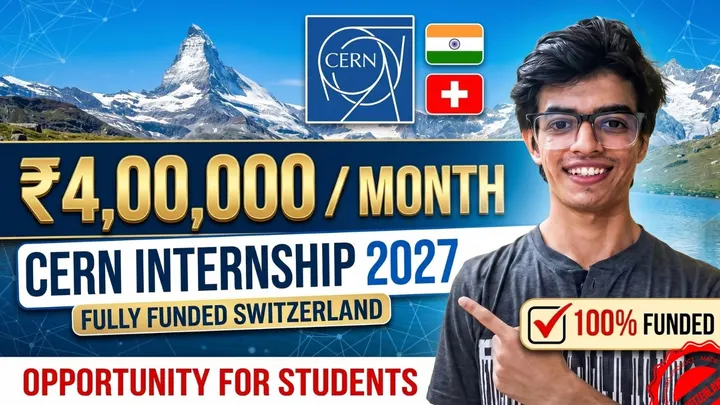
Enjoy the ride, stay curious, and remember that the real value of a CERN summer isn’t just the stipend – it’s the network, the confidence, and the glimpse of what cutting‑edge research feels like. If you want a visual walk‑through of the whole process, check out my video “₹4,00,000Month CERN Internship 2027 🇨🇭 Fully Funded Switzerland Opportunity for Students” linked above. Drop your questions in the comments or ping me on Instagram; I’ll be happy to help you fine‑tune your application.
Happy researching!
Found this useful?

Comments
Questions, experiences, thank-yous: all welcome. No sign-up needed.