Why OIST Picks Certain Interns and How You Can Be One
Discover the exact factors OIST values—academic record, research fit, soft skills, and more—and learn concrete tactics to tailor your application and stand out among Indian candidates.

Chitranshu Rajput
8 min read
OIST internships attract bright minds from all over, but the pool is competitive and the selection isn’t just about a high CGPA.
If you’re wondering why some Indian students get the offer while others don’t, the answer lies in how well their whole profile matches OIST’s mission and the specific labs they’re applying to. Below is a data‑driven look at the criteria OIST uses and a step‑by‑step guide to shape your application so it stands out.
Understanding OIST’s Mission and What It Looks For
Interdisciplinary focus
Okinawa Institute of Science and Technology (OIST) brands itself as a “research‑first” university where biology, chemistry, physics, computer science, and engineering blend seamlessly. The institute’s annual reports show that about 60 % of its projects involve cross‑disciplinary teams. In practice, this means they prefer interns who can speak the language of more than one field and are comfortable jumping between wet‑lab work and data analysis.
Core values that guide intern selection
| Value | What it means for you |
|---|---|
| Scientific curiosity | You should show genuine interest in asking “why” and be able to propose a simple hypothesis or question. |
| Independence | Interns are expected to run small experiments or simulations with minimal supervision. |
| Collaboration | Projects often involve 3–5 people from different labs; teamwork is non‑negotiable. |
| Global mindset | Ability to adapt to a new culture and work in an English‑speaking environment. |
When OIST reviewers scan an application, they map each item to these values. A strong profile checks most boxes, even if the CGPA is modest.
Academic Profile: Beyond CGPA
How OIST evaluates coursework and labs
OIST does not publish a strict CGPA cutoff, but data from past admitted interns (compiled from publicly shared profiles) shows a median undergraduate GPA of around 7.5/10. More important than the number are:
- Relevant coursework – Modules in molecular biology, data science, robotics, or optics that align with the lab’s focus.
- Lab grades – Practical scores often carry more weight than theory marks because they reflect hands‑on ability.
- Consistency – A steady upward trend signals learning ability; a dip followed by recovery is okay if you can explain it.
Leveraging project work, MOOCs, and certifications
- Capstone or final year projects – Highlight any project that produced a prototype, a paper, or a poster. Mention the tools you used (e.g., Python, MATLAB, CRISPR kits) and the outcome.
- MOOCs – Courses from Coursera, edX, or Udacity that cover deep‑learning, bioinformatics, or microfabrication can fill gaps. List the platform, course title, and completion date; a certificate isn’t mandatory but adds credibility.
- Certifications – If you have a recognized badge (e.g., “Google Data Analytics Professional Certificate”), place it under a “Technical Skills” subsection.
Actionable tip: Create a two‑column table in your CV: Coursework on the left, Key Projects/Skills on the right. This makes the relevance instantly visible.
Research Fit: Matching Your Interests with OIST Labs
Identifying labs that align with your background
- Browse the lab directory – Each lab page lists current research themes, recent publications, and the PI’s background.
- Use keyword mapping – Take 3–5 keywords from your own experience (e.g., “single‑cell RNA‑seq”, “soft‑robotics”, “quantum optics”) and search them on the site. Labs that repeatedly appear are good targets.
- Check recent intern stories – OIST’s blog often features former interns; note which labs welcomed students with similar skill sets.
Crafting a concise research interest statement
Your statement should be ≈150 words and answer three questions:
- What problem intrigues you? – “I am fascinated by how neuronal circuits encode memory.”
- Why OIST? – “OIST’s Brain‑Science Lab combines in‑vivo imaging with computational modeling, which matches my training in optics and Python.”
- What can you contribute? – “I can bring experience in building miniaturized microscopes and analyzing calcium‑imaging data.”
Example paragraph (feel free to adapt):
“My undergraduate project on optogenetic stimulation sparked an interest in deciphering neural circuit dynamics. OIST’s Brain‑Science Lab, known for its integration of two‑photon microscopy and deep‑learning analysis, aligns perfectly with my skill set in MATLAB and TensorFlow. I look forward to contributing my experience in designing custom optical setups and writing analysis pipelines for large‑scale imaging datasets.”
Soft Skills and Cultural Fit
Communication, teamwork, adaptability
OIST interns present weekly updates to a mixed audience of senior scientists and fellow interns. To prove you can do this:
- Include a “Presentation Experience” bullet – e.g., “Delivered 10‑minute poster presentation at NIT Trichy’s annual research symposium.”
- Mention any group projects – Highlight your role (lead, coordinator, data analyst) and the outcome.
Showcasing language basics and intercultural experiences
- English proficiency – If you have TOEFL/IELTS scores, list them. Even a brief note like “Score 92 (iBT)” helps.
- Japanese basics – OIST does not require fluency, but a line such as “Completed N5 level Japanese (JLPT) – basic greetings and daily phrases” signals willingness to integrate.
- Travel or exchange programs – Any short‑term study abroad, summer school, or volunteer stint abroad should be listed, emphasizing the cultural adjustment you handled.
Recommendation Letters that Resonate
Who should write them
- Primary academic referee – A professor who supervised your lab work or capstone project.
- Secondary referee – Could be another faculty member, a senior researcher, or a project mentor from an internship.
Avoid using a generic HR manager unless the internship was heavily industry‑focused and the letter can speak to research potential.
Key points to ask recommenders to highlight
- Specific technical skill – “Demonstrated proficiency in CRISPR‑Cas9 vector construction.”
- Independent problem‑solving – “Identified and fixed a contamination issue in the cell‑culture workflow without supervision.”
- Collaboration – “Effectively coordinated a team of three under tight deadlines.”
- Curiosity – “Frequently proposed follow‑up experiments beyond the curriculum.”
Tip: Send a one‑page brief to your referee summarizing these points, plus a short reminder of the project you worked on together. It saves them time and ensures the right details appear.
Application Essentials: CV, SOP, and Email Outreach
Formatting tips for a clean CV
- One page (unless you have extensive publications).
- Header: Name, email, phone (incl. country code), LinkedIn/GitHub links.
- Sections order: Education → Research Experience → Technical Skills → Projects → Presentations → Awards/Certificates → Languages.
- Font: Simple sans‑serif (e.g., Arial 10‑11 pt). Use bold for headings only.
Structuring an SOP that hits OIST’s criteria
| Paragraph | Focus |
|---|---|
| 1 | Your academic background and why you love research. |
| 2 | Specific OIST lab(s) you’re targeting and why they fit. |
| 3 | What you will bring (skills, projects). |
| 4 | Long‑term vision – how the internship fits into your career plan. |
Keep each paragraph to 4‑5 sentences. Avoid generic statements like “I want to become a scientist”; instead, tie it to a concrete goal (e.g., “I aim to develop low‑cost biosensors for rural health monitoring”).
Cold‑email template for lab PIs
Subject: Prospective Summer Intern – Interest in [Lab Name]’s [Research Area]

Dear Prof. [Last Name],

My name is Chitranshu Rajput, a final‑year B.Tech student at NSUT Delhi, specializing in bio‑instrumentation. I was excited to read your recent paper on [specific paper title or topic] and was particularly intrigued by the approach you used for [brief technical detail].

I have hands‑on experience building microfluidic devices (see attached CV) and have processed large imaging datasets using Python. I am keen to contribute to your work on [lab’s current project] and would love to discuss the possibility of a summer internship.

Would you be available for a short 15‑minute call next week? I can share a brief research‑interest statement and a draft project proposal if that helps.

Thank you for considering my request.

Best regards,
Chitranshu Rajput
Phone: +91‑XXXXXXXXXX
LinkedIn: linkedin.com/in/chitranshu‑rajput
What makes it work?
- Specificity – Mention a recent paper and a concrete detail.
- Value proposition – Briefly state what you can do.
- Clear ask – A short call, not a vague “please consider me.”
Attach your CV as a PDF named Chitranshu_Rajput_CV.pdf. Do not attach the SOP; you can offer it later if the PI asks.
Common Pitfalls and How to Avoid Them
| Pitfall | Why it hurts | Fix |
|---|---|---|
| CGPA‑only focus | Reviewers skim past a number without context. | Pair GPA with relevant coursework and projects. |
| Generic SOP | “I love science” reads like a copy‑paste. | Use the 4‑paragraph structure and insert lab‑specific details. |
| Missing contact info | Emails bounce; reviewers can’t reach you. | Double‑check email, phone, and LinkedIn links. |
| Over‑long CV | Important points get lost in the scroll. | Keep to one page; use bullet points, not paragraphs. |
| No proof of English | OIST works entirely in English. | Include TOEFL/IELTS score or a brief note on English-medium education. |
| Skipping the lab‑specific email | You appear as a mass applicant. | Send a tailored email to each lab you apply for. |
| Late submission | Applications close early for internal review. | Aim to submit at least a week before the official deadline. |
Checklist before you hit “Submit”
- CV follows the one‑page clean format.
- SOP has four focused paragraphs and mentions at least one OIST lab.
- Two recommendation letters uploaded, each from a professor who knows your research work.
- English proficiency proof attached (if available).
- Japanese language note added (optional).
- All PDFs named
YourName_Document.pdf. - Email addresses in the application match those on your CV.
Next Steps After Submission
Interview preparation
If you get shortlisted, OIST typically conducts a 30‑minute video interview. Expect:
- Technical questions – Briefly explain a project you listed; be ready to discuss challenges and outcomes.
- Motivation queries – “Why OIST?” “What do you hope to learn?”
- Scenario questions – “How would you handle a failed experiment?”
Prepare by rehearsing short (2‑minute) summaries of your top two projects. Keep a notebook of key metrics (e.g., “improved assay sensitivity by 20 %”) handy.
Follow‑up etiquette and timeline expectations
- Post‑interview email – Send a thank‑you within 24 hours, restating your enthusiasm and a quick recap of how you can add value.
- Decision timeline – OIST usually informs candidates within 2–3 weeks, but it can stretch to a month during peak season. If you haven’t heard after three weeks, a polite inquiry (“I wanted to check on the status of my application for the summer internship”) is acceptable.
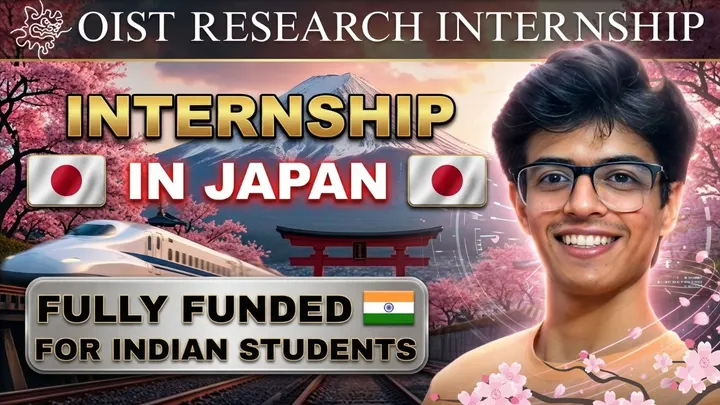
I hope this breakdown gives you a clear roadmap from the first line of your CV to the day you step onto OIST’s campus. If you need a visual walk‑through, check out my video “OIST Internship Japan Explained | ₹1.8L/Month Stipend + Free Accommodation”—it walks through the same points with screenshots of a successful application.
Good luck, and feel free to drop your questions in the comments below. I’ll try to answer as many as I can!
Found this useful?


Comments
Questions, experiences, thank-yous: all welcome. No sign-up needed.