Step‑by‑step timeline to land a Max Planck summer internship
Struggling to organise your Max Planck application? Follow this detailed timeline, complete with checklists, email templates and insider tips, and turn a daunting process into a clear path to a fully funded German research summer.

Chitranshu Rajput
10 min readUpdated 4 views
I’m often asked how to turn a vague idea—“I want to work in a Max Planck lab this summer”—into a concrete offer that lands in your inbox with a clear start date. The process looks messy if you start from scratch, but when you map it out month by month, the steps line up nicely and the anxiety drops dramatically. Below is a 12‑month roadmap that takes you from the first research spark to a confirmed internship at a Max Planck Institute (MPI). All the dates are approximate; always double‑check the official MPI website for the exact deadline for the year you’re applying.
1. Understanding the Max Planck Summer Internship structure
Before you invest time, know what you’re aiming for.
| Aspect | What you’ll see |
|---|---|
| Program types | Most institutes run a “Summer Research Internship” (usually 8 weeks) under the Max Planck Society (MPS) International Summer Internships scheme. A few labs also host “Junior Research Group” projects that are longer but follow a similar application flow. |
| Funding | Fully funded: stipend (covers living expenses, typically €800‑€1 200 per month), round‑trip flight, and accommodation (often a shared dorm or university housing). No tuition or lab fees. |
| Duration | 6‑10 weeks, depending on the institute and the specific project. |
| Eligibility for Indian students | • Enrolled in a Bachelor’s or Master’s program (final year undergrad or any year of Master’s). • Minimum CGPA around 7.0 / 10 (some labs are flexible if you have strong research exposure). • English proficiency (IELTS ≈ 6.0 or TOEFL ≈ 80). • Ability to obtain a short‑term Schengen visa (you’ll need proof of funding and accommodation). |
Most MPI summer internships are advertised once a year—usually between January and March for the upcoming summer. The official portal opens the online application form roughly four months before the deadline. Keep an eye on the MPI website and the institute’s own news page; they post the exact window each year.
2. 12‑month backward planning: setting your target date
Create a reverse calendar
- Mark the final deadline (e.g., 15 May 2027).
- Count back 12 weeks – that’s the latest you should have your offer in hand to sort visas and travel.
- Allocate buffer weeks (10 % of the total time) for unexpected delays—recommendation letters, visa appointments, or a lab asking for a follow‑up interview.
Sample timeline (targeting a June start)
| Month (counting backward) | Key milestone |
|---|---|
| May (deadline month) | Submit complete online application. |
| April | Send final follow‑up emails, confirm interview slots, start visa paperwork. |
| March | Receive interview invitations, prepare answers, finalize recommendation letters. |
| Feb‑Mar | Submit application packet (forms, CV, motivation letter, transcripts). |
| Jan | Draft cold emails, shortlist labs, start reaching out to PIs. |
| Dec–Jan | Shortlist 5‑7 labs, read their recent papers, map your interests. |
| Oct‑Nov | Build a mini‑project or coursework portfolio related to your target area. |
| Jul‑Sep | Identify a research theme, take relevant electives, talk to your professor for a reference. |
| Jun‑Jul | Brainstorm possible topics, read review articles, note gaps you could explore. |
Write these milestones into a Google Sheet or a simple notebook, and set reminders for each buffer week. The visual cue of a calendar makes the whole thing feel doable.
3. Month 1‑3: Building a research profile that stands out
1️⃣ Choose a research theme early
Pick a broad area that aligns with the MPI you’re eyeing—e.g., “nanophotonics,” “computational neuroscience,” or “quantum optics.” Don’t get stuck on a hyper‑specific niche yet; you’ll refine it once you know which labs are active.
2️⃣ Strengthen the academic foundation
- Coursework: Enroll in at least two upper‑level courses that cover the fundamentals of your chosen theme. If your university offers a lab component, prioritize it.
- Online modules: Platforms like Coursera or edX have free courses from German universities (e.g., “Introduction to Quantum Mechanics” from TU Munich). A certificate isn’t mandatory but shows initiative.
3️⃣ Start a mini‑project
Even a 3‑month self‑driven project counts. It could be:
- Re‑implementing a published algorithm in Python and testing it on a public dataset.
- Building a simple optical setup on a breadboard and documenting results.
- Writing a short review (1 000‑1 500 words) on a hot topic in the field.
Document everything in a GitHub repo or a neatly formatted PDF. This becomes the “research brief” you’ll attach to cold emails later.
4️⃣ Secure a faculty reference
Approach a professor who knows your work—preferably someone who has supervised a project or a lab course. Explain your internship goal, share your mini‑project draft, and ask if they’d be willing to write a reference letter (you’ll need a final version later, but an early heads‑up helps). Offer to give them a bullet‑point summary of what you plan to do; it makes their job easier.
Common mistake: Waiting until the last minute to ask for a reference. Professors have teaching loads and grant deadlines; give them at least six weeks before you need the final letter.
4. Month 4‑6: Lab scouting and matching your interests
1️⃣ Use the MPI directory effectively
The Max Planck Society hosts 86 institutes across Germany. Each institute has a dedicated website with:
- Research groups (often called “departments” or “sections”).
- Recent publications (usually a “Publications” tab).
- Contact details for the group leader (PI).
Create a spreadsheet with columns: Institute, Group, PI name, Research focus, Recent paper (title + link), Fit score (1‑5). Fill it as you browse.
2️⃣ Filter by research area
If you’re interested in nanophotonics, start with:
- Max Planck Institute for the Science of Light (MPISL) – Erlangen.
- Max Planck Institute for the Physics of Complex Systems (MPIPKS) – Dresden (some groups work on photonic materials).
For computational neuroscience, look at:
- Max Planck Institute for Brain Research (MPIBR) – Frankfurt.
- Max Planck Institute for Biological Cybernetics (MPBC) – Tübingen.
3️⃣ Read recent papers
Pick the last three papers from each shortlisted group. Skim the abstract, then glance at the methods section. Ask yourself:
- Does the methodology match what I’ve practiced in my mini‑project?
- Is there a clear gap or a question I could help explore during a summer stint?
Write a one‑sentence note under the “Fit score” column summarising why you’re interested.
4️⃣ Shortlist 5‑7 labs
Aim for diversity (different institutes, slightly different sub‑topics) so you have fallback options. Keep the list manageable; you’ll spend time personalising each email.
Common mistake: Sending a generic email to 20+ labs. Personalisation takes a few minutes per lab but dramatically improves response rates.
5. Month 7‑8: Crafting the perfect cold email to a PI
Subject line formula
[Your Name] – Summer 2027 Internship Inquiry – [Research Theme] – [Institute Acronym]
Example: Aarav Sharma – Summer 2027 Internship Inquiry – Quantum Optics – MPQ
Email structure (keep it under 250 words)
- Greeting – “Dear Prof. [Last Name],”
- One‑line hook – Mention a specific paper of theirs you read and why it intrigued you.
- Brief self‑intro – Year, university, CGPA, and a one‑sentence research focus.
- Fit paragraph – Connect your mini‑project or coursework to their current work.
- Request – “I would be grateful if you could consider me for a summer internship in 2027. I have attached a concise CV and a one‑page research brief.”
- Polite close – Thank them for their time and say you’ll follow up in two weeks.
Attachments
- One‑page CV (clear headings, bullet points for skills, no more than two pages total).
- Research brief (PDF, 1‑page summary of your mini‑project, highlighting the problem, method, and results).
- Transcript excerpt (optional; you can mention that the full transcript is available on request).
Sample paragraph
I was particularly fascinated by your recent Nature Communications paper on “Hybrid Plasmonic‑Dielectric Metasurfaces for Beam Steering.” In my own project, I designed a MATLAB simulation of dielectric nano‑antennas and observed similar far‑field patterns. I believe extending this work to your experimental platform could be a productive summer project.
Follow‑up cadence
- First follow‑up: 10 days after the initial email – a short “just checking if you had a chance to look at my CV.”
- Second follow‑up: 7 days later, if no response – politely ask if they need any additional information.
Common mistake: Using attachments that are too heavy (large PDFs, full‑length CVs). Keep each file under 500 KB; compress images if needed.
6. Month 9‑10: Application packet assembly and submission
Once a PI expresses interest (or you get a positive reply asking you to apply through the MPI portal), it’s time to pull everything together.
1️⃣ Online application form
- Personal details – Fill exactly as on your passport.
- Academic history – Upload a scanned copy of your full transcript (official PDF from your university).
- English proficiency – If you have an IELTS/TOEFL score, upload the certificate; otherwise, note that the institute can accept a university‑issued English‑medium statement.
2️⃣ Motivation letter (max 500 words)
Structure:
- Opening – State the institute, the specific group, and the summer term you’re targeting.
- Why this group? – Refer to the paper that sparked your interest and explain how your background aligns.
- What you bring – Summarise your mini‑project, relevant coursework, and any coding or lab skills.
- Future outlook – Briefly mention how the internship fits into your longer‑term goal (e.g., PhD in quantum optics, industry R&D).
- Closing – Thank them and express eagerness to contribute.
Keep the tone professional yet personable; avoid flowery language.
3️⃣ Recommendation letters
Ask your faculty reference (from Month 1‑3) to write a specific letter highlighting:
- Your analytical abilities.
- Any independent research you’ve done.
- Your communication skills (important for an international setting).
Give them a template with bullet points you’d like covered; they’ll appreciate the guidance and you’ll get a stronger letter. Request the PDF by the end of the month so you can upload it before the deadline.
4️⃣ Final checklist before hitting “Submit”
- All PDFs are under 2 MB.
- CV is up‑to‑date (include any recent conference poster or workshop).
- Motivation letter is tailored to the specific MPI group.
- Transcripts show the correct grading scale (convert to 10‑point if needed).
- Recommendation letters attached.
- Double‑checked spelling of PI’s name and institute acronym.
Common mistake: Submitting the application before the portal opens. The MPI system rejects early entries, and you’ll have to start over. Mark the exact opening date in your calendar.
7. Month 11‑12: Follow‑up, interview prep, and final steps
1️⃣ Polite follow‑up after submission
If you haven’t heard back within three weeks, send a brief email to the institute’s administrative contact (usually listed on the application portal):
Dear [Contact Name],
I submitted my summer internship application on [date] for the [Institute/Group] and wanted to confirm that all documents were received. Please let me know if anything else is needed.
Thank you,
[Your Name]
2️⃣ Interview preparation (if invited)
Most MPI groups conduct a 30‑minute video interview via Zoom or Teams. Prepare:
- Two slides: one summarising your mini‑project, another outlining a possible summer plan (objectives, methods, expected outcomes).
- Technical questions – Review the PI’s recent papers; expect a question like “How would you extend this experiment?”
- Soft skills – Be ready to discuss teamwork, time management, and why you want to work in Germany.
Practice with a friend or mentor; keep the presentation under 5 minutes total.
3️⃣ Visa checklist (Schengen short‑stay)
- Acceptance letter from the MPI (official PDF).
- Proof of funding – the stipend letter from MPI plus a bank statement showing you can cover incidental expenses.
- Travel insurance (minimum €30 000 coverage).
- Passport (valid at least 3 months beyond your intended stay).
- Visa appointment – book as soon as you receive the acceptance; slots in German consulates can fill up fast.
4️⃣ Budgeting for travel
Even though the stipend covers accommodation and flights, you’ll need cash for:
- Local transport (monthly public‑transport pass ≈ €70).
- Food (average €200‑€250 per month if you cook).
- Miscellaneous (SIM card, toiletries, occasional outings).
Plan a rough budget of €1 200‑€1 500 for the entire stay and keep a small emergency reserve.
Common mistake: Assuming the stipend will be transferred automatically. Some institutes require you to open a German bank account after arrival; ask the admin contact about the preferred method.
8. After acceptance: making the most of your internship
You’ve got the offer—now turn those eight weeks into a launchpad.
Pre‑arrival reading list
- Key papers from the PI’s group (download PDFs and annotate).
- Review articles on the broader field (help you speak the same language as the lab members).
- German basics – a few phrases for daily life (e.g., “Wo ist die Mensa?”).
Networking tips
- Introduce yourself on the institute’s internal Slack or Teams channel before you arrive (a short “Hello, I’m Aarav, joining the quantum optics group in June”).
- Attend the weekly lab meeting from day one; take notes and ask one thoughtful question per meeting.
- Schedule a coffee chat with a senior PhD student—most are happy to share lab routines and local tips.
Setting research goals
Write a one‑page “Summer Plan”:
- Goal 1 – Replicate a baseline experiment from the PI’s recent paper.
- Goal 2 – Extend it by testing a new parameter (e.g., wavelength range).
- Goal 3 – Draft a short conference abstract (many MPI groups submit interns’ work to the MPS Student Conference).
Share this plan with your PI within the first week; they’ll help you refine it and keep you on track.
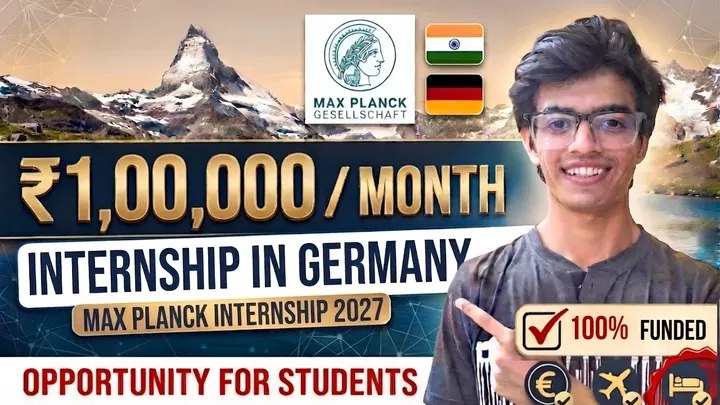
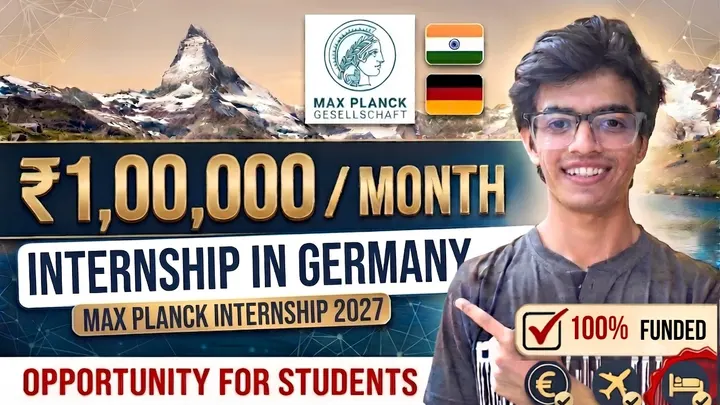
That’s the whole roadmap—from the first spark in July to a signed acceptance and a productive summer in Germany. If any step feels fuzzy, drop a comment below or watch my video “MAX PLANCK INTERNSHIP 2027 🇩🇪 FULLY FUNDED ₹0 Cost Stipend + Flight + Accommodation” where I walk through the same timeline with screenshots of the portal. Good luck, and see you in Europe!
Found this useful?
Comments
Questions, experiences, thank-yous: all welcome. No sign-up needed.