Match Your Research Interests to a Max Planck Lab and Get a Reply
Struggling to find a Max Planck lab that fits your background? This guide shows how to research institutes, map your skills, and write a compelling email that increases your chances of landing a fully funded summer internship.

Chitranshu Rajput
8 min read
I’m sure you’ve stared at the Max Planck website, bookmarked a dozen labs, and wondered why you never hear back. The real problem isn’t the lack of openings – it’s that most cold‑emails miss the mark. Below is the exact workflow I use with every student who wants a funded Max Planck internship: pick the right institute, line up your profile, and write an email that makes a professor want to reply.
Understanding the Max Planck Society
The institute network
The Max Planck Society (MPS) runs more than 80 independent institutes across Germany, each focused on a narrow scientific theme – from Quantum Optics in Erlangen to Neuroscience in Frankfurt. They are grouped into four research pillars (e.g., Physics, Life Sciences, Humanities, and Social Sciences), but the real decision point for you is the individual institute and the research group within it.
Types of summer internships offered
- Max Planck Research Internships (MPRI) – 8‑12 weeks, fully funded (stipend, travel, accommodation).
- Max Planck Junior Research Group (JRG) visits – shorter stays, often for master’s students who already have a paper in hand.
- Student‑exchange projects – coordinated through your home university, usually less competitive but still paid.
All of them expect you to contribute to an ongoing project, not to start a brand‑new thesis.
Eligibility basics for Indian students
- Degree level – currently enrolled in a B.Tech/B.E. (final year) or M.Sc./M.Tech (first two years).
- Academic standing – CGPA of about 7.5 / 10 is the norm; lower scores can work if you have strong research experience.
- Language – most labs work in English; a basic German level helps with daily life but isn’t a formal requirement.
- Visa – you’ll need a short‑term research visa (Schengen) once you have the invitation letter.
The key takeaway: the eligibility filter is fairly low; the real competition is in how well you match the lab’s current needs.
Identifying the Right Institute and Group
Use the official portals
- Start at the MPS “Research” page – it lists all institutes with a one‑sentence description.
- Click the institute that sounds closest to your field; each institute has a “Research Groups” tab showing every professor’s page.
- Open the “Publications” section; most groups list their latest papers (PDFs or links to journals).
Filter by research area and project relevance
- Keyword search – type “machine learning”, “nanophotonics”, or “CRISPR” into the site’s search bar.
- Publication date – focus on papers from the last 2 years; they reveal what the group is actively working on.
- Funding source – if a paper mentions a European Horizon grant or a German DFG project, the group likely has money for interns.
Build a shortlist (3‑5 labs)
Create a simple spreadsheet with columns:
| Institute | Group (Prof.) | Core Topic | Recent Paper (2023‑24) | Funding clues | Why it fits you |
|---|
Limit yourself to five entries. Anything more becomes a distraction and reduces the quality of each email you send.
Mapping Your Profile to the Lab’s Needs
Analyse recent papers for skill gaps
Pick the latest paper from each shortlisted group and note the methods used (e.g., “single‑particle cryo‑EM”, “finite‑element simulations in COMSOL”, “TensorFlow for protein folding”). Write down the technical keywords you already know and the ones you don’t.
- If you lack a method, think of a related skill you do have (e.g., you’ve used MATLAB for data analysis, which can be transferred to Python‑based simulations).
- If you have the method, prepare a one‑sentence bullet that proves it (e.g., “Implemented a 3‑D finite‑element model of a micro‑cavity in COMSOL for my final year project”).
Highlight coursework, projects, and any publications
- Coursework – list only the most relevant (Advanced Quantum Mechanics, Machine Learning, Bioinformatics).
- Projects – pick one or two that show you can work independently for 4‑6 weeks, mirroring an internship timeline.
- Publications – even a conference abstract counts; place it under a “Research Experience” heading in your CV.
Prepare a concise research statement
Your statement should be 150 words max and answer three questions:
- What is the lab currently doing? – reference the specific paper you read.
- What can you contribute? – match your skill list to the methods.
- What do you hope to learn? – a short, genuine learning goal (e.g., “gain hands‑on experience with cryo‑EM sample preparation”).
Keep it focused; the professor will skim it while reading your email.
Crafting a Personalized Cold Email
Subject line that catches attention
- Bad: “Internship request”
- Good: “Interest in Prof. Müller’s 2027 cryo‑EM project – [Your Name, IIT‑Delhi, CGPA 8.2]”
The subject tells the professor what and who instantly.
Email structure
| Part | What to write | Tips |
|---|---|---|
| Greeting | “Dear Prof. Müller,” | Use the exact title from the website. |
| Intro | One line: who you are, where you study, and why you’re writing. | Example: “I am a final‑year B.Tech student at NSUT, Delhi, focusing on computational materials science.” |
| Relevance | Mention the specific paper/project and why it excites you. | Quote the paper title and a single finding that resonated. |
| Ask | State the internship request clearly and the time window. | “I would like to join your group for a 10‑week MPRI in the summer of 2027.” |
| Closing | Thank them, attach CV and research statement, and invite a brief call. | “I have attached my CV and a one‑page research statement for your convenience. I would be grateful for a 15‑minute chat at your earliest convenience.” |
| Signature | Full name, degree, university, phone, LinkedIn (optional). | Keep it compact. |
Attachments
- CV – one page, clean layout, bold the section headings.
- One‑page research statement – same as the paragraph you prepared, formatted as a PDF.
Tone and length guidelines
- Tone – respectful but conversational, as if you’re writing to a senior colleague.
- Length – 150‑200 words total; the professor should finish before the first coffee break.
- Formatting – plain text email (no HTML) with a clear subject line; avoid fancy fonts or colors.
Sample email (realistic, not a copy‑paste)
Subject: Interest in Prof. Müller’s 2027 cryo‑EM project – Ananya Sharma, NSUT (CGPA 8.2)

Dear Prof. Müller,

I am a final‑year B.Tech student at NSUT, Delhi, specializing in computational materials science. I recently read your paper “High‑resolution cryo‑EM of 2D perovskite interfaces” (Nature 2024) and was fascinated by the way you combined phase‑contrast imaging with machine‑learning segmentation.

My master’s project involved developing a Python pipeline for TEM image denoising, and I have hands‑on experience with COMSOL and TensorFlow. I believe I could contribute to the data‑analysis side of your upcoming 2027 MPRI, while learning the cryo‑EM workflow you described.

Would you consider me for a 10‑week internship starting June 2027? I have attached my CV and a brief research statement outlining how my skills align with your current work. I would be happy to discuss this further over a short call at your convenience.

Thank you for your time and consideration.

Best regards,
Ananya Sharma
B.Tech (Materials Science), NSUT, Delhi
+91‑98765 43210 | ananya.sharma@email.com | LinkedIn: /in/ananyasharma
Follow‑Up Strategy That Works
Timing of the first follow‑up
- Wait 7‑10 days after the initial email. Professors receive dozens of messages daily; a polite reminder shows persistence without pestering.
What to include in the reminder
- Keep the subject the same, prefix with “Re:” so it threads.
- Add a single line: “I wanted to check if you had a chance to look at my previous email regarding a 2027 MPRI.”
- Re‑attach the CV and research statement (some email clients strip attachments on replies).
Handling no‑response scenarios
- If no reply after two weeks, send a second, even shorter reminder (one sentence).
- If still silent after another week, move on to the next lab on your shortlist.
- Never send more than three emails to the same professor; after that it looks like spam.
Preparing for the Interview and Acceptance
Common interview questions
- Why this lab and not another Max Planck institute? – reference the specific paper and your skill match.
- Describe a technical challenge you faced in a project and how you solved it. – pick a concise example from your CV.
- What do you hope to achieve in 8‑10 weeks? – give a realistic goal (e.g., “produce a cleaned dataset of 500 cryo‑EM images”).
Documents to have ready
- Signed invitation letter (once the professor confirms).
- Passport (valid ≥ 6 months).
- Proof of health insurance – German statutory or a private plan accepted for the Schengen visa.
- Funding proof – the stipend letter from MPS plus a bank statement showing you can cover any extra costs.
- Academic transcripts – scanned PDFs, preferably notarised if the embassy asks.
Tips for a smooth transition to Germany
- Open a German bank account online (N26, DKB) before you arrive; it speeds up salary receipt.
- Register your address within two weeks of landing (the “Anmeldung”) – many universities help international interns.
- Learn a few everyday German phrases; even “Guten Tag” at the lab door makes a good impression.
Real Student Examples and Templates
Sample email that secured a placement
Subject: Interest in Prof. Klein’s 2027 quantum‑optics internship – Rohan Patel, IIT‑Kanpur (CGPA 8.5)
Dear Prof. Klein,
I am a third‑year M.Sc. student in Physics at IIT‑Kanpur. Your recent work on “Entanglement‑enhanced metrology” (PRL 2023) aligns perfectly with my thesis on squeezed‑state generation using lithium‑niobate waveguides.
I have built a fiber‑coupled setup for homodyne detection and written LabVIEW scripts for real‑time data acquisition. I would love to contribute to your group’s upcoming 2027 MPRI and learn the experimental techniques you described.
Please find my CV and a one‑page research statement attached. I am available for a short call next week if you wish to discuss further.
Thank you for considering my application.
Best,
Rohan Patel
The professor replied within three days, invited Rohan for a video call, and later sent the official invitation.
Brief case studies
| Student | Background | Lab chosen | Key matching point | Outcome |
|---|---|---|---|---|
| Meera (B.Tech, 8.4 CGPA) | Computational chemistry | Max Planck Institute for Chemical Energy Conversion | Experience with DFT calculations on metal‑organic frameworks (same as the lab’s recent paper) | 10‑week fully funded internship, later a PhD offer |
| Arjun (M.Sc., 7.7 CGPA) | Neuroscience, EEG analysis | Max Planck Institute for Brain Research | Built a Python pipeline for real‑time EEG artifact removal (lab needed similar skill) | Accepted after one follow‑up; stipend covered travel |
Downloadable templates
- Cold‑email template – a fill‑in‑the‑blank version of the sample above (PDF).
- One‑page research statement template – sections for “Lab relevance”, “My skills”, “Learning goal”.
- CV checklist for Max Planck – bullet list of must‑include items (publications, technical skills, language proficiency).
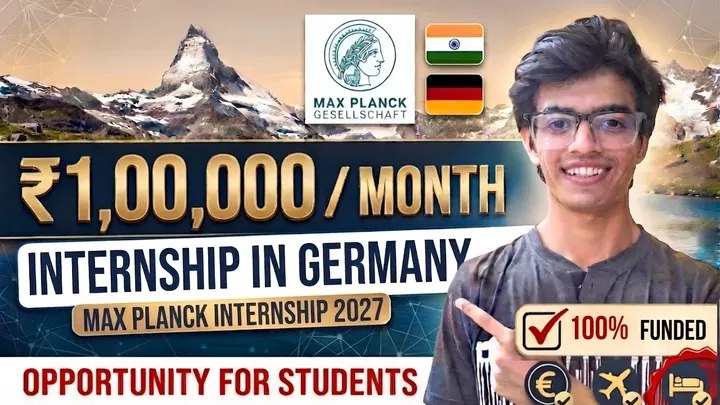
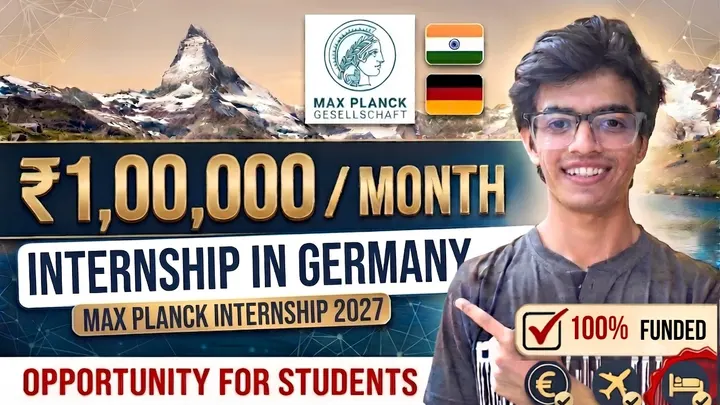
You can find all three files in the description of my video “MAX PLANCK INTERNSHIP 2027 🇩🇪 FULLY FUNDED ₹0 Cost Stipend + Flight + Accommodation”. I walk through each attachment and show how to customize them for any institute.
If you follow these steps, you’ll stop sending generic “I want an internship” mails and start sending targeted proposals that professors actually read. Got a question about a specific lab or need feedback on your draft email? Drop a comment below or ping me on LinkedIn – I’m happy to help. And don’t forget to watch the video linked at the top for a quick visual recap. Good luck, and see you in Germany!
Found this useful?

Comments
Questions, experiences, thank-yous: all welcome. No sign-up needed.