University vs Embassy MEXT Recommendation: Which Wins
Unsure whether to apply for MEXT through a university or the Japanese embassy? This guide breaks down pros, cons, timelines, and hidden tricks so you can pick the path that best fits your profile.

Chitranshu Rajput
10 min readUpdated 1 view
When you sit down to plan a MEXT scholarship, the first question that pops up is: Should I go for a university recommendation or an embassy recommendation? Both routes can land you a fully‑funded spot in Japan, but they differ in eligibility, timing, and the kind of support you’ll get. Below I break down the two paths side‑by‑side, point out the hidden traps, and give you a checklist to decide which one fits your profile best.
Understanding the Two Paths
What is a university recommendation?
A university‑recommended MEXT (sometimes called “research student” or “undergraduate student” MEXT, depending on the program) is offered by a Japanese university that has been allotted a certain number of scholarships by the Ministry of Education, Culture, Sports, Science and Technology (MEXT). The university itself selects the candidate and forwards the application to the Ministry.
Who can apply?
- Students who have already secured a place (or are about to secure a place) at the host university, usually as a research student, exchange student, or short‑term researcher.
- Most often, the university asks you to send a research proposal or a statement of purpose, and they may require a professor’s endorsement.
What is an embassy recommendation?
An embassy‑recommended MEXT is handled by the Indian Embassy in Tokyo (or the regional consulates). The Ministry allocates a pool of scholarships to each embassy, and the embassy runs its own selection process based on the applications it receives.
Who can apply?
- Any Indian student who meets the broad MEXT eligibility criteria (undergraduate, master’s, PhD, or research).
- You do not need a pre‑existing link with a Japanese university, although you will have to indicate a preferred university later in the process.
The big picture
MEXT scholarships are funded by the Japanese government, not the university or the embassy. The difference lies in who shortlists you and how the paperwork moves. In the university route, the host institution vouches for you first; in the embassy route, the Indian diplomatic mission does the initial vetting and then forwards the file to the Ministry.
Eligibility and Eligibility Nuances
| Criterion | University Recommendation | Embassy Recommendation |
|---|---|---|
| CGPA | Usually a minimum of 7.5/10 for undergrad, 8.0/10 for post‑grad. Some top universities (UTokyo, Kyoto) may ask for 8.5+. | Same baseline, but embassies sometimes relax the CGPA for Tier‑2 colleges if other strengths (research, publications) are strong. |
| Language | Must show at least JLPT N2 or TOEFL/IELTS scores as per the university’s requirement. | Minimum TOEFL iBT 80 or IELTS 6.0 is the norm; Japanese language is optional unless you apply for a Japanese‑medium program. |
| Research / Project | A concrete research proposal aligned with a faculty member’s work is often mandatory. | You need a clear study plan, but a professor’s endorsement is not required at the application stage. |
| University‑specific restrictions | Some universities only accept candidates from certain Indian institutes (e.g., IITs, NITs) for their quota. | No such restriction; the embassy’s pool is open to all eligible Indian students. |
| Special cases for Tier‑2 colleges | If you are from a non‑top‑tier Indian college, you may still qualify if you have a strong professor’s letter from the Japanese university. | Embassies sometimes give extra weight to students from Tier‑2 colleges who have high extracurricular or research achievements. |
Takeaway: If your CGPA is just above the minimum and you have a solid research idea, the university route can give you a stronger endorsement. If you’re worried about university‑specific cut‑offs, the embassy route offers a broader safety net.
Application Timeline and Document Flow
Typical schedule (you’ll need to verify exact dates on the official sites)
| Phase | University Route | Embassy Route |
|---|---|---|
| Jan–Feb | University opens internal call for MEXT candidates. You start contacting professors. | Embassy announces opening of its MEXT intake. |
| Mar–Apr | Submit research proposal, CV, transcripts to university’s international office. | Submit online application to the embassy portal (including study plan, CV, transcripts). |
| May–Jun | University forwards shortlisted candidates to MEXT (Ministry). | Embassy shortlists and forwards selected applications to MEXT. |
| Jul–Aug | Ministry reviews; successful candidates receive the “MEXT University Recommendation” letter. | Ministry reviews; successful candidates receive the “MEXT Embassy Recommendation” letter. |
| Sep–Oct | Visa processing; you get the Certificate of Eligibility (COE) from the university. | Visa processing; embassy helps you obtain the COE (often the university still issues it). |
| Nov–Dec | Arrival in Japan, orientation, start of program. | Same. |
Document preparation order
- Transcripts & CGPA conversion – Get an official copy and, if needed, a conversion sheet for foreign grading.
- Language certificates – JLPT, TOEFL, or IELTS. Apply early; results can take weeks.
- Research proposal / Study plan – Tailor it to the university’s strengths if you’re applying through them; keep it broader for embassy applications.
- Recommendation letters – For university route, you need a Japanese professor’s letter (or at least a draft). For embassy route, two academic references from Indian professors are enough.
- Financial documents – Not required for MEXT (it’s fully funded), but the embassy may ask for proof of bank balance for visa purposes.
When to start contacting professors or embassies?
- University route: Begin outreach 3–4 months before the university’s internal deadline. Professors are busy, and a polite, concise email can make a big difference.
- Embassy route: You can start the online application as soon as the portal opens, but have your study plan ready 2 months in advance to avoid last‑minute rush.
Pros and Cons: Success Factors
Success rate (rough guidance)
- University recommendation often enjoys a slightly higher acceptance rate because the host university has already vetted you. Think of it as a “pre‑screened” batch.
- Embassy recommendation covers a larger applicant pool, so the competition can be tougher, especially for popular universities like Tokyo or Osaka.
Note: Exact percentages change yearly; always check the latest figures on the MEXT website.
Strength of recommendation letters
- University route: The Japanese professor’s letter carries weight because it shows the host lab already trusts you. It also gives you a chance to discuss your research fit directly.
- Embassy route: Indian professors’ letters are fine, but they lack the direct connection to the Japanese host. You’ll need a compelling study plan to compensate.
Funding amount and stipend variations
Both routes provide the standard MEXT package: monthly stipend (usually around ¥140,000‑¥150,000), round‑trip airfare, and tuition waiver. Some universities add a research allowance or housing support on top of the standard package, which you’ll see only in the university‑recommended offer.
Impact on post‑MEXT career
- University recommendation often leads to smoother continuation into a PhD or a full‑time research position at the same university, because you’ve already built a relationship with the faculty.
- Embassy recommendation gives you flexibility to switch universities after the first year, but you may need to re‑apply for a “research student” status if you change labs.
Strategic Decision‑Making Checklist
Self‑assessment questionnaire
Is my CGPA ≥ 7.5 (undergrad) / 8.0 (post‑grad)?
- If yes, both routes are open.
- If borderline, lean toward embassy (they sometimes give leeway).
Do I have a concrete research idea that matches a Japanese professor’s work?
- Yes → university recommendation is stronger.
- No → embassy route is safer.
Can I secure a Japanese professor’s endorsement within 2–3 months?
- Yes → go university.
- No → embassy.
Am I applying from a Tier‑2 Indian college?
- Yes → consider embassy, unless you have a standout research paper or internship.
Do I prefer to lock in a university early (to arrange housing, etc.)?
- Yes → university route.
- No → embassy gives you more flexibility later.
When to pursue dual applications?
If you have time and resources, applying through both channels can double your chances. Keep the documents separate (different recommendation letters, study plans) to avoid mixing up the processes. However, be mindful of the application fees (embassy route may have a nominal processing charge) and the extra workload.
Risk mitigation tips
- Backup professor list: Reach out to at least three potential supervisors; keep a polite follow‑up schedule.
- Document version control: Name files clearly (e.g.,
KittuKun_Transcript_UTokyo.pdf). - Deadline buffer: Aim to submit at least a week before the official deadline to handle unexpected portal glitches.
- Stay updated: Subscribe to the official MEXT mailing list and the Indian Embassy’s newsletter; dates can shift by a few weeks.
Real Student Experiences
Case 1: Anurag, B.Tech (Mechanical) – University Recommendation
Anurag secured a place at Kyushu University after emailing Prof. Tanaka with a 2‑page research sketch on lightweight composites. The professor replied within a week, asked for a draft, and later sent a recommendation letter. Kyushu’s international office forwarded his file to MEXT, and he received the scholarship on the first round.
Lesson: A well‑targeted research proposal and early professor contact can fast‑track the university route. Anurag’s CGPA was 7.6, just above the cut‑off, but the professor’s confidence in his project compensated for the modest score.
Case 2: Sneha, MSc (Physics) – Embassy Recommendation
Sneha’s CGPA was 7.2, and she came from a Tier‑2 college. She applied through the Indian Embassy in Tokyo with a strong statement of purpose focusing on quantum optics. The embassy interview panel liked her interdisciplinary background and awarded her a scholarship for University of Tsukuba. She later contacted a professor there and was accepted as a research student.
Lesson: The embassy route can level the playing field for students with slightly lower CGPA or from less‑known institutes, provided the study plan is compelling.
Common pitfalls
- Late professor outreach – waiting until the university’s internal deadline leaves no room for revisions.
- Copy‑pasting study plans – embassies spot generic statements quickly; personalize each paragraph.
- Ignoring language requirements – some universities reject applications outright if JLPT N2 isn’t shown, even if the embassy route would accept you.
Action Plan: From Choice to Submission
Below is a step‑by‑step guide you can follow once you’ve decided which path to take.
1. Finalise your route
- Tick the checklist items above.
- If you qualify for both, decide whether you have the bandwidth for dual applications.
2. Gather core documents
| Document | University route | Embassy route |
|---|---|---|
| Official transcripts | ✔ | ✔ |
| CGPA conversion sheet | ✔ | ✔ |
| Language certificate | ✔ (JLPT N2 or higher) | ✔ (TOEFL/IELTS minimum) |
| Research proposal / Study plan | ✔ (focused) | ✔ (broader) |
| Recommendation letters | ✔ (Japanese professor) + 1 Indian | ✔ (2 Indian professors) |
| Passport copy | ✔ | ✔ |
| Photo (passport size) | ✔ | ✔ |
3. Draft the outreach email
Template for university professors
Subject: Prospective MEXT Research Student – Interest in [Lab/Group Name]

Dear Prof. [Surname],

My name is Chitranshu Rajput (B.Tech, [Your Indian Institute]), and I am applying for the MEXT University Recommendation for the 2027 intake. I have been following your recent work on [specific paper/project] and feel my background in [your skill/experience] aligns well with your group’s objectives.

I have attached a brief research proposal (≈800 words) and my CV. Could we schedule a 15‑minute call next week to discuss possible fit? I would be grateful for any guidance you can provide regarding the MEXT application process at [University].

Thank you for your time.

Warm regards,
Chitranshu (KittuKun)
Phone: +91‑XXXXXXXXXX
Email: yourmail@example.com
Template for embassy contact (if you need clarification)
Subject: Query Regarding MEXT Embassy Recommendation – 2027

Dear Sir/Madam,

I am an Indian student (B.Tech, [College]) interested in applying for the MEXT Embassy Recommendation for the 2027 academic year. Could you please confirm the minimum language requirements and whether a research proposal is mandatory at the application stage?

Thank you for your assistance.

Best,
Chitranshu Rajput
Phone: +91‑XXXXXXXXXX
4. Follow the timeline
| Week | Action |
|---|---|
| 0‑2 | Secure language certificates; request transcripts. |
| 2‑4 | Finalise research proposal / study plan; get it proofread by a senior. |
| 4‑6 | Send outreach emails to professors (university route) or submit embassy portal draft. |
| 6‑8 | Collect recommendation letters; ask professors for any required forms. |
| 8‑10 | Upload all documents to the university portal or embassy portal. |
| 10‑12 | Double‑check file names, run a final plagiarism check on the study plan, and submit. |
| 12+ | Keep an eye on email for interview calls or additional document requests. |
5. Pre‑submission checklist
- All PDFs are under 2 MB and readable.
- Names match exactly across passport, transcripts, and certificates.
- Study plan is ≤ 800 words for university route, ≤ 1000 words for embassy route.
- Two reference letters are signed and on official letterhead.
- Language certificate score is clearly visible.
- You have a backup copy of every file saved on Google Drive and a USB stick.
Once you hit Submit, the rest is largely out of your hands. Keep your phone charged; the embassy or university may call for a short interview.
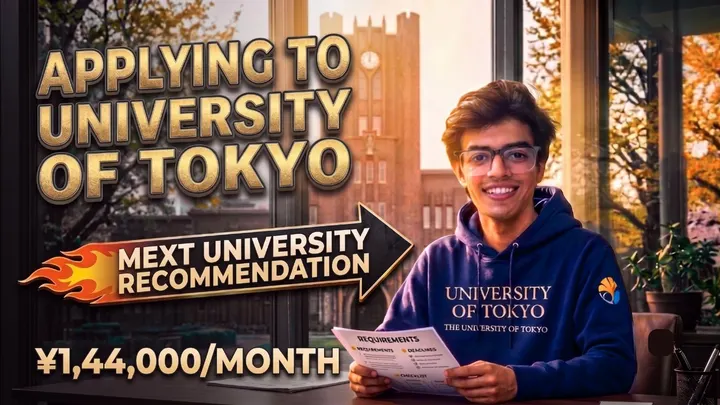
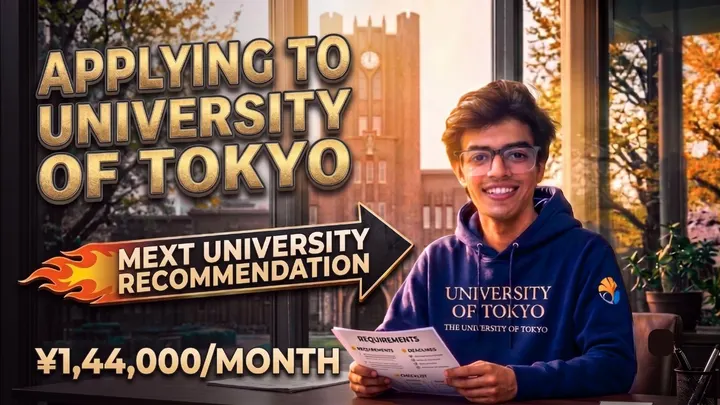
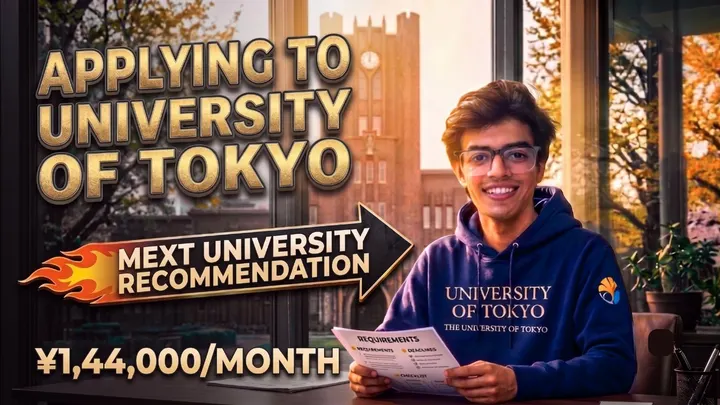
That’s the whole roadmap from choosing between university and embassy recommendation to hitting the final submit button. If you’re still unsure which path suits you, feel free to drop a comment below – I’ll try to help you weigh the options. And if you want a visual walk‑through, check out my video “How to Apply to the University of Tokyo 🇯🇵 MEXT University Recommendation 2027” that’s embedded above; it walks through the university route step by step.
Good luck, and may your MEXT adventure start soon!
Found this useful?

Comments
Questions, experiences, thank-yous: all welcome. No sign-up needed.