Mastering the METI Japan Internship Application Step by Step
Learn the exact sequence of documents, timelines and insider tricks needed to ace the METI Japan internship – even if your CGPA isn’t perfect.

Chitranshu Rajput
9 min read
The METI internship is a fantastic way for an Indian engineering or science student to spend a summer working in a Japanese government‑affiliated lab or company, earn a stipend, and build a network that can open doors to future PhDs or full‑time jobs. If you’re staring at the application portal and wondering where to start, you’re not alone. Below is a hands‑on walk‑through that breaks down every form, deadline and tip so you can submit a flawless application with confidence.
Overview of the METI Internship Program
What the program offers
- Real‑world research or industry exposure – you work on a project that aligns with Japan’s Ministry of Economy, Trade and Industry (METI) priorities, such as AI, renewable energy, or advanced manufacturing.
- Fully funded stay – a monthly stipend that covers living expenses, plus round‑trip airfare (subject to change each year).
- Cultural immersion – short orientation, language support, and a chance to explore life in Japan beyond the lab.
Who can apply (Indian students)
| Requirement | Typical condition |
|---|---|
| Academic level | Undergraduate (3rd or 4th year) or master’s student. |
| CGPA | Usually 7.0 / 10 or higher; some universities accept a slightly lower score if other parts of the profile are strong. |
| Language | No formal Japanese test required, but basic reading ability helps with daily life. English proficiency is a must. |
| Citizenship | Must hold Indian passport; permanent residents of other countries are not eligible. |
| Availability | Full‑time for the 3‑month summer window (June‑August). |
How METI differs from other Japan scholarships
- Duration – unlike the year‑long MEXT scholarship, METI is a short summer stint, so you can still finish your degree in India.
- Funding structure – stipend is paid monthly rather than a lump‑sum scholarship; there is no tuition waiver because you are not enrolled in a Japanese university.
- Application route – you apply directly through the METI portal, not via your home university’s international office (though you will need a letter of approval from them).
Timeline and Deadlines at a Glance
| Milestone | Approx. period (check official site) |
|---|---|
| Call for applications opens | Early February |
| Internal deadline (your university’s approval) | Mid‑March |
| Portal submission deadline | Late March (usually the last Friday) |
| Selection results announced | Early May |
| Visa & travel arrangements | May‑June |
| Internship start | Early June |
Setting personal milestones
- Week 1‑2 (Feb) – Read the official METI guidelines, note the exact portal deadline, and download the application template.
- Week 3‑4 (Feb‑Mar) – Talk to your department head for the “no‑objection” letter; start gathering transcripts and contacting referees.
- Week 5‑6 (Mar) – Draft the research proposal and motivation letter; get feedback from a senior friend or mentor.
- Week 7 (mid‑Mar) – Polish the documents, rename files, and do a test upload on the portal (most portals let you save a draft).
- Week 8 (late Mar) – Submit the final application before the portal closes; keep a screenshot of the confirmation page.
Treat each week as a mini‑deadline; it keeps the workload manageable and reduces last‑minute panic.
Preparing Core Documents
Academic transcript formatting
- PDF only – scanned copies are fine, but the file must be searchable (OCR).
- Uniform layout – start with a cover page that lists your name, roll number, program, and the university’s name.
- Include grading scale – METI reviewers may not be familiar with the Indian 10‑point system; add a note like “CGPA = 7.5 / 10 (equivalent to ≈ 3.7 / 4.0)”.
- Seal & signature – request the registrar to stamp the transcript; a digital signature is acceptable if the university issues e‑transcripts.
Crafting a compelling research proposal
Your proposal is the heart of the application. Keep it concise (≈ 500 words) and structured:
- Title – precise, no jargon. Example: “Optimising Low‑Power CNN Inference on Edge Devices for Smart Agriculture”.
- Background (2‑3 sentences) – why the problem matters, linking it to METI’s strategic goals (e.g., sustainable agriculture, Industry 4.0).
- Objective – a single, measurable goal.
- Methodology (3‑4 bullet points) – the key steps you’ll take, tools you’ll use, and any collaboration with the host lab.
- Expected outcome – a tangible deliverable (prototype, dataset, report) and how it benefits both Japan and India.
Tip: Mirror the wording from the host lab’s project description. If the lab mentions “development of a real‑time control algorithm,” use the same phrase in your proposal. It shows you’ve read the material carefully.
Writing a concise motivation letter
A good motivation letter is one page and answers three questions:
- Why METI? – connect your career goals with Japan’s industrial policy.
- Why this host lab/company? – mention a specific project or professor’s recent paper that excites you.
- What will you bring? – list two technical strengths (e.g., Python + TensorFlow, PCB design) and a soft skill (teamwork, cross‑cultural communication).
Sample paragraph (feel free to adapt):
“Having worked on a low‑cost IoT sensor for water‑quality monitoring during my final year project, I am eager to deepen my understanding of edge‑AI optimisation. The research group at XYZ Corp, led by Dr Sato, recently published a paper on ultra‑low‑power inference that aligns perfectly with my interests. I believe my experience with embedded C and my recent certification in TensorFlow Lite will allow me to contribute meaningfully to their summer project while learning cutting‑edge techniques that I can later apply to Indian agriculture challenges.”
Proofread for grammar, keep the tone sincere, and avoid generic statements like “I have always wanted to go to Japan”.
Securing Strong Recommendations
Choosing the right referees
- Academic referee – preferably your project supervisor or a professor who knows your research work.
- Industry referee (optional) – if you have an internship or part‑time job, a senior manager can speak to your professional conduct.
Avoid selecting a professor who barely knows you; a lukewarm letter hurts more than no letter at all.
Providing a briefing kit
Send each referee a zip file containing:
- Your updated CV (PDF, 1‑2 pages).
- Draft of your research proposal – they can quote specific sections.
- Key points you’d like highlighted – e.g., “Please mention my role in the sensor design and my ability to meet tight deadlines.”
- Deadline reminder – clearly state the submission date (include a calendar invite if you’re tech‑savvy).
Sample email template for professors
Subject: Request for Recommendation – METI Japan Internship (deadline: 25 Mar)

Dear Prof. Sharma,

I hope you are well. I am applying for the Ministry of Economy, Trade and Industry (METI) summer internship in Japan and would be grateful if you could write a recommendation letter for me.

The portal requires a PDF upload by 25 March. I have attached a brief briefing kit that includes my CV, the research proposal I intend to submit, and a few bullet points that might help you.

If you need any additional information, please let me know. I can also provide a draft if that saves you time.

Thank you very much for considering my request.

Best regards,
Chitranshu (KittuKun)
B.Tech – Computer Science, NSUT Delhi
Send the email at least three weeks before the deadline; follow up politely a week before the due date.
Filling the METI Online Portal Correctly
Step‑by‑step navigation
- Create an account – use your university email; you’ll receive a verification link.
- Select “New Application – Summer Internship” – choose the year (e.g., 2025) from the dropdown.
- Personal details – fill exactly as they appear on your passport; any mismatch can trigger a visa issue later.
- Academic section – upload the formatted transcript (file name:
Name_Transcript.pdf). - Project section – copy‑paste the research proposal into the provided text box and upload the PDF version (
Name_Proposal.pdf). - Motivation letter – same as above (
Name_Motivation.pdf). - Recommendations – upload each referee’s PDF (
RefereeName_METI.pdf). - Host lab details – enter the lab name, supervisor’s email, and a short description of the project (use the same wording as the lab’s website).
- Review screen – the portal highlights any missing fields in red; fix them before proceeding.
- Submit – click “Finalize Submission” and wait for the confirmation page. Take a screenshot and save the PDF receipt.
Common pitfalls and how to avoid them
| Pitfall | Why it happens | Fix |
|---|---|---|
| Passport number typo | Copy‑pasting from an older document. | Type it manually, then double‑check each digit. |
| File size exceeds limit | Scanned transcripts can be large. | Compress PDFs using a free online tool (keep under 5 MB). |
| Missing “host supervisor email” | Some students think the lab name is enough. | The portal requires a valid email; ask your host to confirm it. |
| Wrong naming convention | The system can’t parse the file. | Follow the exact pattern shown in the portal help page. |
| Late submission | Time‑zone confusion – the portal uses JST. | Set a personal reminder for 2 PM IST on the deadline day (which is 10 AM JST). |
Uploading files with proper naming conventions
- Transcript:
KittuKun_Transcript.pdf - Proposal:
KittuKun_Proposal.pdf - Motivation:
KittuKun_Motivation.pdf - Recommendation 1:
ProfSharma_Recommendation.pdf - Recommendation 2 (if any):
MgrRao_Recommendation.pdf
Keep the names short, avoid spaces, and use only alphanumeric characters and underscores.
Financial & Visa Preparations After Selection
Understanding stipend disbursement
- Monthly stipend – typically paid directly to your Indian bank account via international transfer. Expect a processing lag of 2‑3 weeks after the first month starts.
- Airfare – the program usually covers a round‑trip ticket from India to Japan; the amount varies, so verify the exact figure on the official page.
Visa application checklist
- Certificate of Eligibility (COE) – the host institution sends this to you; you need it to apply for a “Cultural Activities” or “Student” visa.
- Completed visa form – available on the Japanese embassy website.
- Passport (valid for at least 6 months)
- Recent passport‑size photo (white background).
- Proof of financial means – recent bank statement showing the stipend amount (or a sponsor letter).
- Invitation letter from METI – PDF provided after selection.
Apply for the visa as soon as you receive the COE; processing can take 7‑10 working days, sometimes longer during peak travel seasons.
Budgeting for arrival costs
| Item | Typical range (₹) |
|---|---|
| Flight (economy, round‑trip) | 55 000 – 80 000 |
| Initial accommodation (first month, share‑house) | 30 000 – 45 000 |
| Transportation (airport‑to‑city, monthly rail pass) | 8 000 – 12 000 |
| Daily meals & misc. | 15 000 – 20 000 per month |
| Emergency buffer | 30 000 |
The stipend usually covers most of these, but keep a small emergency fund for unexpected expenses.
Final Checklist and Post‑Submission Follow‑Up
Last‑minute review items
- All PDFs open correctly on a different device.
- Names, dates, and passport numbers match everywhere.
- Files follow the naming convention.
- You have saved the confirmation screenshot.
- Your referees have received a copy of the uploaded recommendation (optional but polite).
How to politely follow up
If you haven’t heard back within two weeks after the portal deadline, send a brief email to the METI support address:
Subject: Follow‑up on METI Summer Internship Application (Name – Application ID 12345)

Dear METI Team,

I hope you are doing well. I submitted my application on 24 Mar 2025 (Application ID 12345) and wanted to confirm that all documents were received correctly.

Thank you for your time.

Best,
Chitranshu (KittuKun)
One polite reminder is enough; avoid repeated inquiries.
What to do while waiting for results
- Keep the host lab informed – a short note saying “Looking forward to hearing from METI; I’ll keep you posted” maintains goodwill.
- Prepare for interviews – some years the selection panel holds a short video interview; rehearse answers about your project motivation and technical background.
- Apply to backup options – consider applying to OIST, GKS, or a corporate internship simultaneously; the timelines often overlap, and having alternatives reduces stress.
I hope this walkthrough clears the fog around the METI internship application. The process is a series of small, manageable steps; treat each one like a mini‑project and you’ll finish with a polished submission.
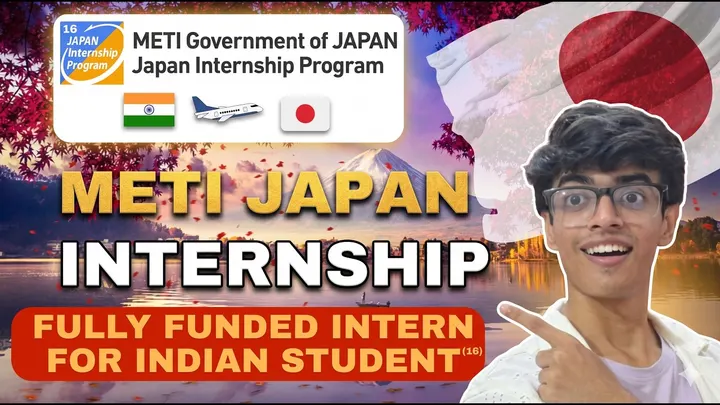
If you found this guide useful, check out my video “How Indian Students Can Go to Japan 🇯🇵 METI Internship Guide” for a visual walk‑through of the portal and a few extra tips on interview prep. Feel free to drop your questions or share your own experience in the comments – I love hearing how the community is moving forward. Good luck, and see you in Japan!
Found this useful?

Comments
Questions, experiences, thank-yous: all welcome. No sign-up needed.