Beyond MEXT: Little‑Known Fully Funded Japan Scholarships for Indian Students
Discover five fully funded Japanese scholarships that aren’t MEXT, learn their eligibility, deadlines, and exact application steps, and start planning your study abroad journey today.

Chitranshu Rajput
10 min readUpdated 2 views
I’m often asked why I keep mentioning scholarships other than MEXT when Indian students talk about studying in Japan. The short answer is simple: MEXT is fantastic, but it’s not the only path to a fully‑funded stay, and its slots are limited, competition is fierce, and the eligibility boxes don’t fit everyone. If your CGPA is a shade below the usual cut‑off, you’re interested in a specific research niche, or you’d rather land in a city that isn’t a typical MEXT hub, you have solid alternatives. Below is a practical guide to five lesser‑known, fully funded Japanese scholarships that Indian candidates can target, plus checklists, timelines and writing tips that will help you put together a strong application.
Why Look Beyond MEXT?
Limitations of MEXT
MEXT scholarships are administered by the Japanese Ministry of Education, Culture, Sports, Science and Technology. They are generous—tuition, monthly stipend, travel allowance—but they come with a few constraints:
- Fixed fields – most programmes focus on broad disciplines (engineering, science, humanities). Niche areas such as robotics‑industry collaborations or data‑science labs tied to a private firm are rarely covered.
- Strict academic thresholds – the average CGPA of successful candidates hovers around 8.0 / 10 (or 3.5 / 4.0). A lower score doesn’t automatically disqualify you, but it makes the competition steeper.
- One‑year window – applications are accepted only once a year, and the deadline falls in early spring. Missing it means waiting another twelve months.
Benefits of Alternative Scholarships
Non‑MEXT awards often fill the gaps left by the government programme:
- Tailored research themes – many are tied to a specific university lab, corporate R&D unit or bilateral project, giving you a clearer fit if your interests line up.
- More flexible eligibility – some accept a broader CGPA range, consider work experience, or weigh extracurricular impact heavily.
- Multiple intake cycles – a few programmes open applications twice a year, which can shorten your wait time.
Overview of Funding Scope
All five scholarships listed below cover tuition, a monthly living allowance (usually comparable to MEXT’s 140,000 JPY range), round‑trip airfare and, in most cases, health insurance. The Toyota Woven Institute internship also adds a travel stipend for field visits. None require you to pay tuition up front, and most provide a modest research budget for consumables.
Top Five Non‑MEXT Fully Funded Scholarships
1. JASSO University‑Specific Scholarships
The Japan Student Services Organization (JASSO) partners with individual universities to award scholarships that match the host institution’s priorities. Examples include the Osaka University International Student Scholarship and the Kyoto University Graduate Fellowship.
- Who funds it? JASSO (public) plus the host university.
- What it covers? Tuition, monthly stipend (≈130‑150 k JPY), travel allowance.
- Typical focus – graduate research in engineering, life sciences, and emerging tech labs that have international collaboration agreements.
2. Japan‑Asia Bridge Program (JAB)
A bilateral initiative between the Japanese Ministry of Foreign Affairs and several Asian governments, JAB aims to cultivate future leaders in regional cooperation.
- Who funds it? Japanese government (via JICA) and the applicant’s home‑country ministry.
- What it covers? Full tuition, monthly stipend (≈120‑140 k JPY), round‑trip ticket, plus a short orientation in Tokyo.
- Typical focus – public policy, sustainable development, and technology transfer projects that involve both Japan and the applicant’s country.
3. Mitsui & Co. Scholarship
Mitsui, a global trading house, runs a scholarship for Indian students pursuing graduate studies in fields that support its business lines (e.g., renewable energy, logistics, AI).
- Who funds it? Mitsui & Co. (corporate).
- What it covers? Tuition, monthly stipend (≈150 k JPY), travel, plus a summer internship at a Mitsui affiliate.
- Typical focus – applied research with commercial potential, especially in sustainability and smart‑city technologies.
4. Nagoya University G30 Program
Nagoya’s “Global 30” (G30) initiative reserves a set of fully funded seats for outstanding international students, especially from India, to join its graduate schools.
- Who funds it? Nagoya University (government‑seeded).
- What it covers? Tuition waiver, monthly stipend (≈140 k JPY), travel allowance, and a research grant for lab consumables.
- Typical focus – engineering, nanotechnology, and interdisciplinary science projects with an international collaboration component.
5. Toyota Woven Institute Internship (Full Stipend)
The Woven Institute, Toyota’s R&D arm, offers a 6‑month fully funded internship for graduate students working on next‑gen mobility, AI, or robotics.
- Who funds it? Toyota Motor Corporation.
- What it covers? Full stipend (≈160 k JPY per month), travel, accommodation (company housing), and a mentorship program.
- Typical focus – hands‑on product development, prototype testing, and data‑driven research.
Eligibility Checklist for Each Scholarship
| Scholarship | Academic Criteria | Language | Nationality / Residency | Special Conditions |
|---|---|---|---|---|
| JASSO Uni‑Specific | Minimum 7.0 / 10 CGPA (or equivalent) for master’s; 7.5 / 10 for PhD | TOEFL ≥ 80 or IELTS ≥ 6.0; Japanese not mandatory unless lab requires | Indian citizen (passport) | Must have a confirmed admission offer from the host university |
| Japan‑Asia Bridge | 6.5 / 10 CGPA acceptable if strong project proposal | English proficiency as above; Japanese optional | Indian citizen, nominated by Ministry of External Affairs (or equivalent) | Project must involve bilateral cooperation; usually a 2‑year master’s track |
| Mitsui & Co. | 7.5 / 10 CGPA preferred; relevant work or project experience valued | TOEFL ≥ 85; basic Japanese (N5) helpful | Indian citizen; residency not a factor | Must submit a corporate‑interest statement; internship component mandatory |
| Nagoya G30 | 7.0 / 10 CGPA; research proposal scored by faculty panel | TOEFL ≥ 80; Japanese optional but beneficial | Indian citizen; must hold a bachelor’s degree from a recognized Indian university | Preference for candidates with published papers or strong lab experience |
| Toyota Woven | 7.5 / 10 CGPA; demonstrable coding/robotics skills | TOEFL ≥ 90; Japanese not required | Indian citizen; must be enrolled in a master’s program in Japan | Internship limited to students in AI, robotics, or automotive‑related fields |
Quick Self‑Assessment
- Do you have a confirmed admission offer? If not, start with JASSO or Nagoya G30, where the university can act as a sponsor.
- Is your CGPA below 7.0 / 10? Consider Japan‑Asia Bridge or Mitsui, which weigh project relevance higher.
- Do you have industry experience? Mitsui and Toyota look favorably on internships or project work.
Application Timeline and Required Documents
Tip: Keep a master spreadsheet with separate tabs for each scholarship. Track deadlines, required documents, and status (draft, reviewed, submitted).
| Phase | Typical Period (2025‑2026) | Action Items |
|---|---|---|
| Research & Contact | Sep – Nov (preceding year) | Identify target universities, labs, or corporate contacts. Reach out to potential supervisors with a concise 150‑word email. |
| Document Preparation | Dec – Jan | Collect transcripts, English test scores, and CV. Draft SOPs (one per scholarship) and recommendation‑letter requests. |
| Submission Window | Feb – Mar (most scholarships) | Upload PDFs to the portal, double‑check file size limits, and pay any nominal processing fee. |
| Interview / Additional Screening | Apr – May | Prepare for a 15‑minute video interview; rehearse answers about research goals and why the sponsor’s focus matters. |
| Offer & Visa | Jun – July | Once you receive the award letter, apply for a student or internship visa at the Japanese embassy in New Delhi. |
Core Documents Checklist
- Curriculum Vitae – 1‑page, reverse‑chronological; include project titles, tools used, and outcomes (e.g., “Reduced energy consumption by 12 % in prototype”).
- Statement of Purpose / Motivation Letter – 500‑800 words; address the sponsor’s mission, your fit, and future impact.
- Academic Transcripts – Official PDFs, sealed if required; translate to English/Japanese if not already.
- English Proficiency Proof – TOEFL/IELTS score report.
- Research Proposal – 1‑page abstract + 2‑page detailed plan (only for research‑heavy scholarships).
- Recommendation Letters – 2 letters; ask supervisors early and provide them a bullet‑point brief of your achievements.
Sample Recommendation‑Letter Request Template
Subject: Request for Recommendation Letter – Japan Scholarship Application

Dear Prof. [Name],

I hope you are doing well. I am applying for the [Scholarship Name] to pursue a master’s in [Program] at [University]. The deadline is [Date], and the selection committee asks for a 2‑page letter highlighting my research abilities and academic performance.

Could you kindly write a recommendation for me? I have attached my CV, a draft SOP, and a brief outline of the project I plan to undertake, which aligns with your work on [Topic]. I would be happy to discuss any details over a call.

Thank you very much for your support.

Best regards,
[Your Name]
Crafting a Winning Application
Tailoring Motivation Letters
Each sponsor looks for a slightly different story:
- JASSO – Emphasize your willingness to integrate into the university community and contribute to ongoing lab work. Mention any prior exposure to Japanese culture (e.g., participation in a Japan‑India cultural fest).
- Japan‑Asia Bridge – Focus on how your project will strengthen Japan‑India ties. Cite a specific policy or development goal (e.g., “enhancing renewable‑energy grids in rural India”).
- Mitsui – Highlight commercial relevance. Show that your research could translate into a product or service that aligns with Mitsui’s business sectors.
- Nagoya G30 – Stress academic rigor. Reference published papers, conference presentations, or patents.
- Toyota Woven – Bring out your hands‑on experience. Talk about any prototype you built, code repository you maintain, or hackathon win related to mobility.
Structure (keep it under 800 words):
- Opening hook – a single sentence that ties your personal motivation to the sponsor’s theme.
- Academic background – concise bullet‑style achievements (CGPA, key courses).
- Research/Project fit – describe the problem, your proposed method, and expected impact in 2‑3 sentences.
- Future contribution – how you will give back to Japan‑India collaboration or the sponsor’s ecosystem after graduation.
- Closing – reaffirm enthusiasm and thank the committee.
Highlighting Indian Projects & Community Impact
Indian reviewers (or alumni panels) appreciate concrete examples. If you led a solar‑panel installation in a village, mention the number of households benefitted and any media coverage. If you organized a coding club, note the membership growth and any outreach to under‑represented students. These details make your profile stand out beyond grades.
Common Pitfalls and How to Avoid Them
| Pitfall | Why it hurts | Fix |
|---|---|---|
| Generic SOP | Shows you haven’t researched the sponsor. | Insert the sponsor’s exact program name, recent news (e.g., “Mitsui’s 2024 green‑hydrogen initiative”), and link your goals to it. |
| Over‑loading the CV | Recruiters skim; too much info hides key achievements. | Keep to 1 page, use bold for project titles, and quantify results. |
| Missing translations | Some universities reject non‑English PDFs. | Get certified translations early; keep originals handy for embassy use. |
| Late recommendation letters | Professors may delay, causing a rushed submission. | Request at least 3 weeks before the deadline and send a polite reminder a week prior. |
| Ignoring visa prep | Even with a scholarship, a visa denial stalls everything. | After award, book an appointment at the Japanese embassy, prepare the “Certificate of Eligibility” (COE) from your host, and have financial proof (even if funded) ready. |
Visa, Travel, and Pre‑Departure Essentials
Student vs. Internship Visa Basics
- Student Visa (Category D) – Required for master’s/PhD programmes (JASSO, JAB, Mitsui, Nagoya G30). You’ll need a COE from the university, a passport‑size photo, and proof of funds (the scholarship letter usually satisfies this).
- Internship Visa (Category C) – For the Toyota Woven internship. The host company issues a “Certificate of Eligibility for Intern Training,” and you must show a detailed training plan.
Budgeting Even with Full Funding
Full funding covers tuition and a stipend, but you’ll still need to manage:
| Expense | Approx. Monthly Cost (JPY) | Approx. INR (at 0.55 JPY/INR) |
|---|---|---|
| Accommodation (shared apartment) | 60 k | 1.1 Lakh |
| Food & groceries | 30 k | 55 k |
| Local transport | 10 k | 18 k |
| Miscellaneous (SIM, books) | 5 k | 9 k |
Plan a modest emergency buffer (≈300 k JPY) for unforeseen travel or medical costs. Most universities have on‑campus housing at lower rates; apply early.
Cultural Preparation Resources
- NHK World Easy Japanese – 48 short videos; great for daily conversation.
- “Japan Guide” app – Offline maps, etiquette tips, public‑transport routes.
- Alumni WhatsApp groups – Search for “KittuKun Japan Alumni” on Facebook; you’ll find senior Indian students who share apartment listings and grocery‑store hacks.
Next Steps: Building a Competitive Profile Now
- Start a research project early – Even a semester‑long lab stint or a faculty‑guided literature review can become a solid bullet point. Aim to produce a short write‑up or poster; you can later turn it into a conference abstract.
- Learn Japanese incrementally – Enroll in a local “Nihongo” class (e.g., at the Japan Foundation Delhi) and aim for JLPT N5 within six months. It’s not mandatory for most scholarships, but it shows commitment and eases daily life.
- Network with alumni – Attend webinars hosted by Japanese universities’ Indian alumni chapters. Ask specific questions: “What did the selection committee value most in your SOP?” or “How did you negotiate the stipend conversion?”
- Polish your online presence – Keep a LinkedIn profile updated with project links, GitHub repositories (for tech‑focused scholarships), and a short “About” section that mentions your Japan‑bound goal.
If you follow the checklist, respect the timelines, and tailor each document to the sponsor’s vision, you’ll significantly improve your odds of landing a fully funded seat.
I’ve walked this path myself—applying to a JASSO scholarship, then later securing a corporate internship with Toyota’s Woven Institute. The difference was always in the details: a crisp email to a professor, a motivation letter that spoke the sponsor’s language, and a proactive approach to visa paperwork.
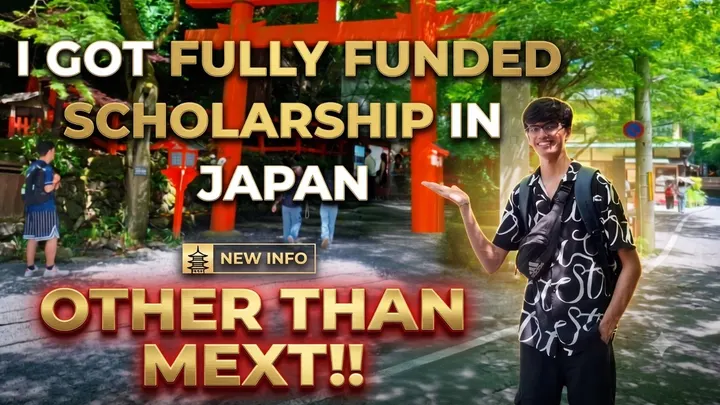
Watch my video “🇯🇵 I Got a 100% Fully Funded Scholarship to Japan Not MEXT!” for a behind‑the‑scenes look at the document drafts and interview prep. And if anything in this guide feels unclear, drop a comment below or ping me on Instagram. I’m happy to help you fine‑tune your application. Good luck, and see you in Japan!
Found this useful?


Comments
Questions, experiences, thank-yous: all welcome. No sign-up needed.